
The Global Market Model is the world's most comprehensive database of integrated market information Forecasts for over 30,000+ markets are updated every six months on the basis of

Economic Factors

Geo-political Factors

Sector-specific factors
- Current Forecast July 2026
- Next Forecast January 2027
Real Growth Analysis
Want to understand how the market is truly growing over time?
See real growth rates (without inflation)to get a clearer picture of actual market performance.
Nominal Growth Overview
View how each industry is growing in current market prices (with inflation) — a snapshot of overall market expansion.
- All Markets
- Aerospace And Defence
- Agriculture
- Chemicals
- Construction
- Electrical And Electronics
- Financial Services
- Food And Beverages
- Healthcare Services
- Hospitality
- Information Technology
- Machinery
- Media
- Medical Equipment
- Metal And Minerals
- Mining
- Oil And Gas
- Paper, Plastics, Rubber, Wood And Textile
- Pharmaceuticals
- Professional Services
- Recreation
- Retail And Wholesale
- Services
- Transport
- Transport Services
- Utilities
- Veterinary Healthcare
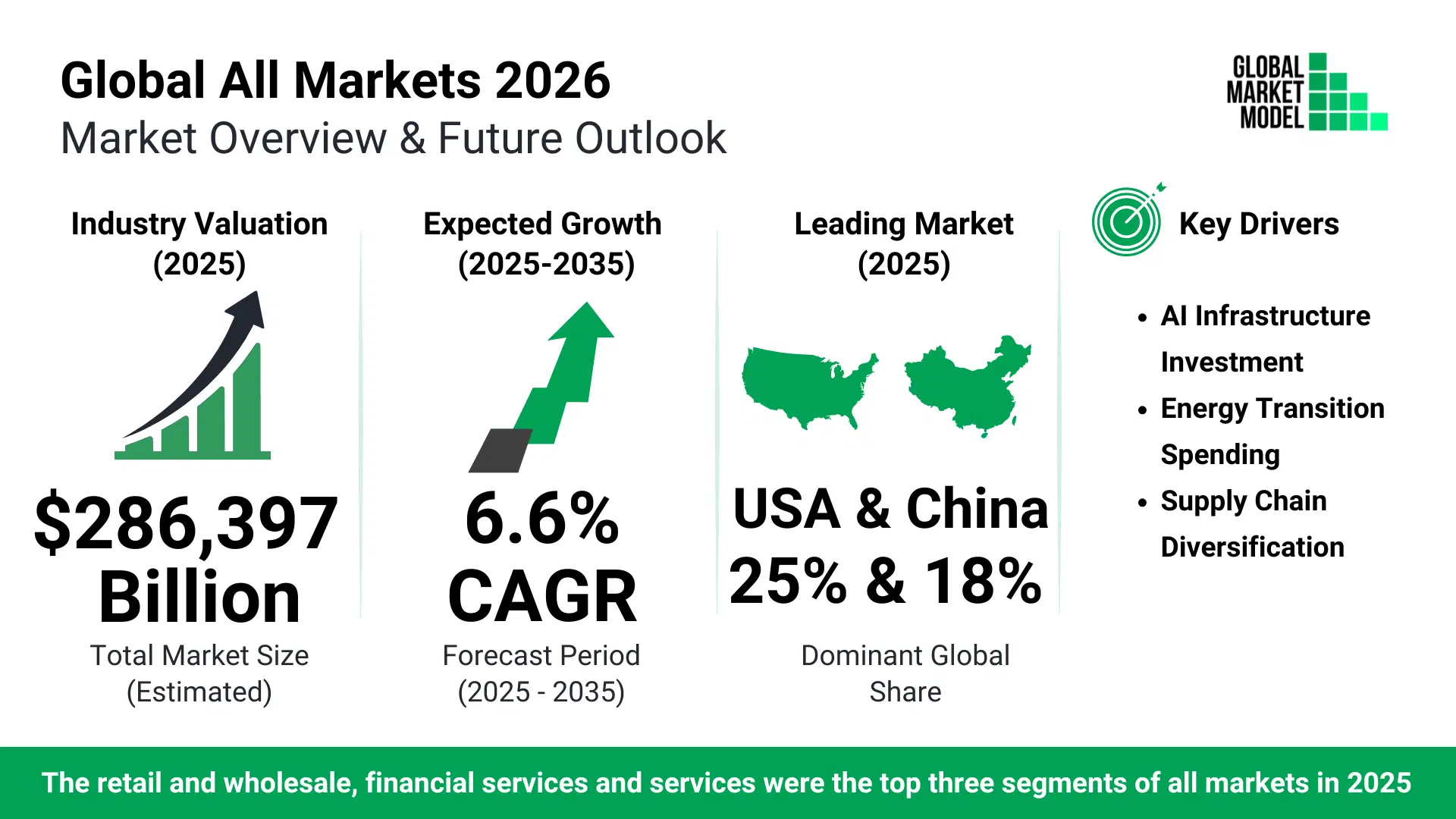
Global Markets Valued at $286.4 Trillion in 2025, Forecast to Grow at a 6.6% CAGR Through 2035
According to the latest Global Market Model forecast, the global market is expected to maintain strong growth through 2035. Despite geopolitical uncertainty, changing trade policies, and more disciplined capital allocation, underlying global market fundamentals remain resilient. Investment in artificial intelligence, healthcare innovation, digital infrastructure, renewable energy, and supply chain resilience is expected to support continued market expansion.
Key global market statistics:
- Global market size: $286,397 billion in 2025
- Global market CAGR: 6.6% from 2025 to 2035
- Forecast period: 2025 to 2035
What Is the Fastest-Growing Global Market?
The medical equipment market is expected to be the fastest-growing global market between 2025 and 2035, supported by technological innovation and rising healthcare demand. Advances in robotics, artificial intelligence, diagnostic technologies, and minimally invasive treatments are creating new opportunities across the medical equipment industry.
Market growth is also being supported by aging populations, increasing rates of chronic diseases, and the expansion of healthcare infrastructure in emerging economies.
Medical equipment market statistics:
- Growth ranking: Fastest-growing global market
- Projected CAGR: 8.9% from 2025 to 2035
What Is the Slowest-Growing Global Market?
The metal and mineral market is expected to be the slowest-growing global market between 2025 and 2035, with growth influenced by structural changes in energy, manufacturing, and sustainability.
The global transition toward decarbonization and renewable energy is reducing demand for some metals associated with fossil fuel industries. At the same time, higher recycling rates, increased adoption of lightweight materials, and sustainability-focused policies are influencing long-term market expansion.
Metal and mineral market statistics:
- Growth ranking: Slowest-growing global market
- Projected CAGR: 4.1% from 2025 to 2035
What Is the Largest Global Market by Industry?
The retail and wholesale market was the largest global industry market in 2025, accounting for 31.5% of the total global market value. Financial services and services ranked second and third, respectively.
Largest global markets by industry share in 2025:
- Retail and wholesale: 31.5%
- Financial services: 12.6%
- Services: 6.0%
The concentration of market value across these industries highlights the continued importance of consumer spending, financial activity, and service-based industries to the global economy.
Which Countries Have the Largest Global Market Share?
The United States and China were the two largest national markets in 2025. Together, they accounted for a substantial share of total global market value and continued to play a central role in global demand, investment, manufacturing, technology, and innovation.
Leading countries by share of global market value in 2025:
- United States: 25%
- China: 18%
Global Market Outlook to 2035
The global market outlook remains positive, with overall markets projected to grow at a 6.6% CAGR through 2035. However, growth is expected to vary considerably across industries. Medical equipment is positioned for the strongest expansion, while the metal and mineral market is expected to experience more moderate growth.
For businesses, investors, and policymakers, these differences highlight the importance of understanding industry-specific market growth, emerging opportunities, regional market dynamics, and long-term global market trends when making strategic decisions.
Key Trends Reshaping Global Markets
The latest Global Market Model forecast highlights several structural developments that are influencing business strategies and market performance across industries.
Tariff Risk Becomes a Long-Term Strategic Consideration
Tariff uncertainty, particularly surrounding trade policy developments under the Donald Trump administration, has increasingly become a structural planning factor rather than a temporary disruption. Businesses are incorporating tariff scenarios into sourcing, pricing, manufacturing, and investment decisions, particularly across electronics, transport equipment, machinery, and industrial supply chains.
Supply Chain Diversification Accelerates
Supply chain diversification has shifted from strategic planning to active implementation. While China continues to play a central role in global manufacturing, companies are expanding production capacity across India, Vietnam, Mexico, and other Southeast Asian economies to improve resilience and reduce geopolitical and tariff-related risks.
Capital Expenditure Becomes More Disciplined
Businesses globally are taking a more selective approach to capital spending, prioritizing investments with clearer returns and shorter payback periods. Large discretionary investments, particularly in commercial construction, enterprise IT, and advanced healthcare infrastructure, are increasingly being phased or scaled according to financial performance and strategic priorities.
Artificial Intelligence Investment Concentrates on Core Infrastructure
Investment in artificial intelligence remains strong but increasingly focused on foundational infrastructure, including data centres, cloud platforms, server GPUs, and foundation model development. While enterprise adoption of AI applications continues to expand, organizations remain focused on achieving sustainable commercial returns before accelerating broader deployment.
Regional Growth Patterns Continue to Diverge
Economic performance continues to vary significantly across major regions. The United States has demonstrated relative resilience, supported by stable consumer demand and strong service-sector activity, while China's recovery has remained uneven due to continued weakness in property and construction markets, affecting industrial production and commodity demand.
Energy Transition Investment Remains Resilient
Despite broader caution around corporate investment, spending on renewable energy, grid modernization, electric vehicle infrastructure, energy storage, and green chemicals has remained relatively strong. Long-term government policy commitments and multi-year infrastructure projects continue to support investment across clean energy industries.
Inventory Management Returns to Normal
Following prolonged destocking cycles in previous years, many industries have transitioned toward inventory normalization rather than aggressive restocking. This has resulted in more balanced demand across manufacturing, retail, and logistics while contributing to greater supply chain stability without triggering excessive inventory accumulation.
The Global Market Model provides comprehensive market intelligence across more than 30,000 markets, including:
- Global, regional, and country-level market forecasts
- Historical and forecast market values
- GDP contribution
- Market segmentation and benchmarking
- Number of enterprises
- Number of employees
- Cross-industry comparisons
- Economic and sector-specific forecasting
Want deeper insights into global markets, country-level forecasts, and cross-industry benchmarks?Request a Demo
The Global Market Model is the world's largest database of market forecasts. Forecasts for over 30,000 markets are updated semi-annually on the basis of economic, geo-political and sector-specific factors. The current forecast was made in July 2026, revising the previous forecasts made in January 2026.

The world's most comprehensive database
- Contact Information
For further insights and detailed information,
please reach out to:
Global Market Model - Europe: +44 788 2955 267
- Asia: +44 788 2955 267 & +91 88972 63534
- Americas: +1 310 496 7795
Aerospace and Defense Market Forecast 2025–2035: Defense Modernization, Space Investment, and Aviation Recovery Drive Long-Term Growth
Aerospace and Defense Market Size and Forecast Through 2035
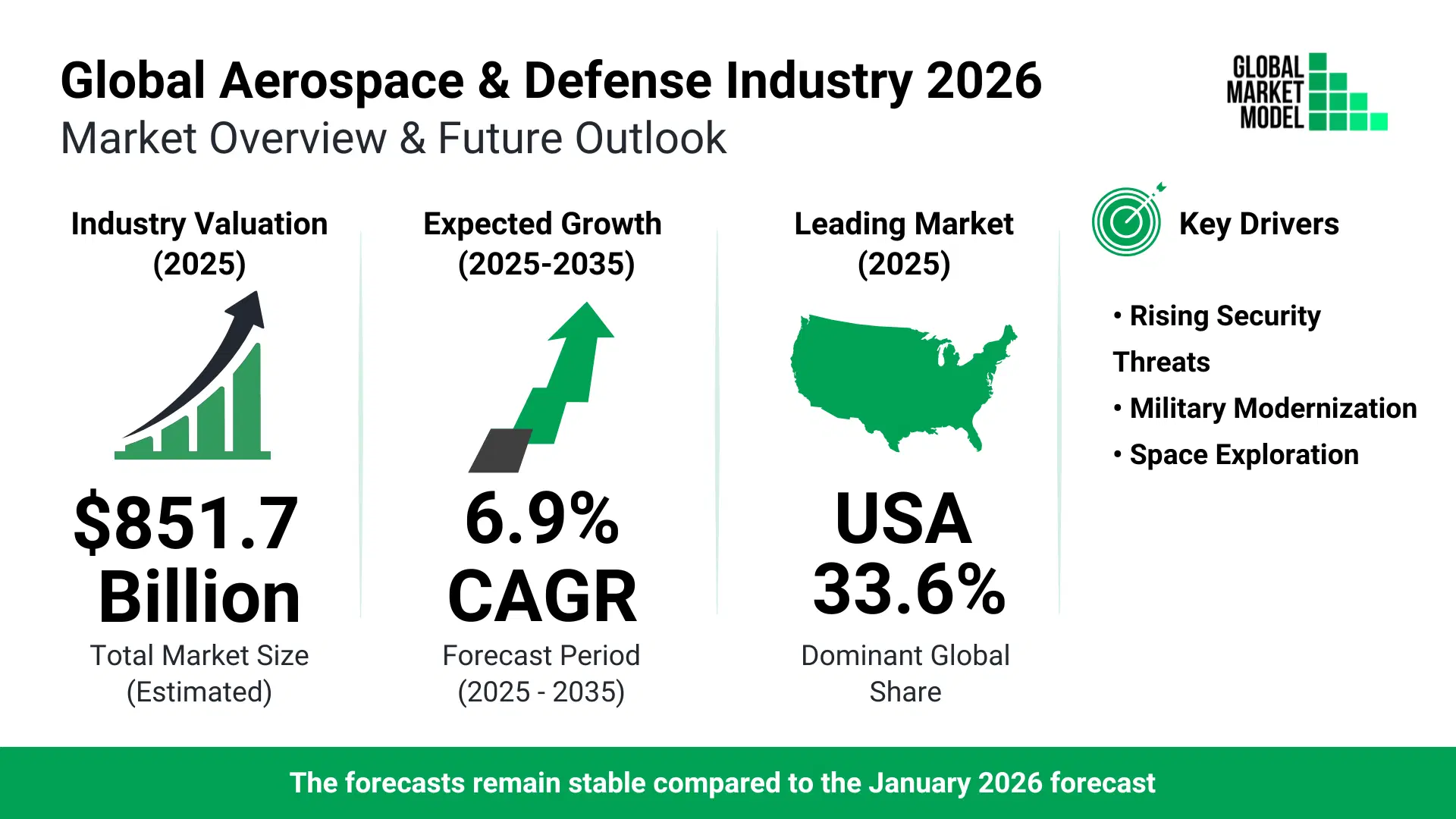
According to the latest Global Market Model forecast, the global aerospace and defense market was valued at $851.7 billion in 2025 and is expected to grow at a CAGR of 6.9% from 2025 to 2035. The market continues to benefit from sustained defense spending, expanding commercial aviation, and accelerating investment in next-generation aerospace technologies.
What's Driving Growth in the Aerospace and Defense Market?
The market's long-term expansion is being supported by several structural trends:
- Rising geopolitical tensions and national security priorities
- Increasing defense budgets across major economies
- Military modernization and procurement programs
- Growth in space exploration and satellite infrastructure
- Adoption of AI, autonomous systems, drones, cyber defense, and advanced communications
- Recovery in commercial aviation and fleet expansion
These factors are reshaping both military and civil aerospace investments globally.
Defense Remains the Largest Segment in the Aerospace and Defense Industry
Defense continues to account for the majority of industry revenue, representing 59.8% of the global aerospace and defense market in 2025.
Growth is supported by continued investments in:
- Autonomous and unmanned defense platforms
- Network-centric warfare systems
- Cybersecurity and space-based surveillance
- Advanced missile and communication technologies
At the same time, commercial aerospace manufacturers are operating under increased regulatory scrutiny, particularly around aircraft safety, manufacturing quality, and delivery timelines.
Regional Outlook: The USA Continues to Lead Global Aerospace and Defense Spending
The United States accounted for 33.6% of the global aerospace and defense market in 2025, driven by high defense expenditure, technological leadership, and continuous investment in military modernization.
Other major regions continue expanding investments in aerospace manufacturing, defense capabilities, and space programs as governments prioritize strategic resilience and national security.
Market Stability Despite Geopolitical Uncertainty
The July 2026 forecast remains largely unchanged from the previous forecast, reflecting resilient demand across the sector.
Industry stability has been supported by:
- Consistent government procurement
- Ongoing fleet modernization
- Recovery in commercial air travel
- Continued investment in cybersecurity, unmanned systems, and next-generation aircraft
Although geopolitical events, including the Iran-Israel conflict, have created localized supply chain and cost pressures, increased military spending has largely offset these challenges, supporting a positive long-term market outlook.
The Global Market Model provides detailed aerospace and defense industry intelligence, including -
- Government expenditure on defense
- Number of enterprises
- Number of employees
- Market forecasts across countries and regions
- Historical and forecast market values
- Sector-specific growth drivers and economic indicators
Want deeper insights into the global aerospace and defense market, country-level forecasts, and industry benchmarks?Request a Demo
The Global Market Model is the world's largest database of market forecasts. Forecasts for over 30,000 markets are updated semi-annually on the basis of economic, geo-political and sector-specific factors. The current forecast was made in July 2026, revising the previous forecasts made in January 2026.
The world's most comprehensive database
- For further information and inquiries:
Global Market Model - Europe: +44 788 2955 267
- Asia: +44 788 2955 267 & +91 88972 63534
- Americas: +1 310 496 7795
Global Agriculture Market Forecast 2025–2035: Food Security, Precision Farming, and Sustainable Agriculture Shape Future Growth
Agriculture Market Size and Growth Forecast Through 2035
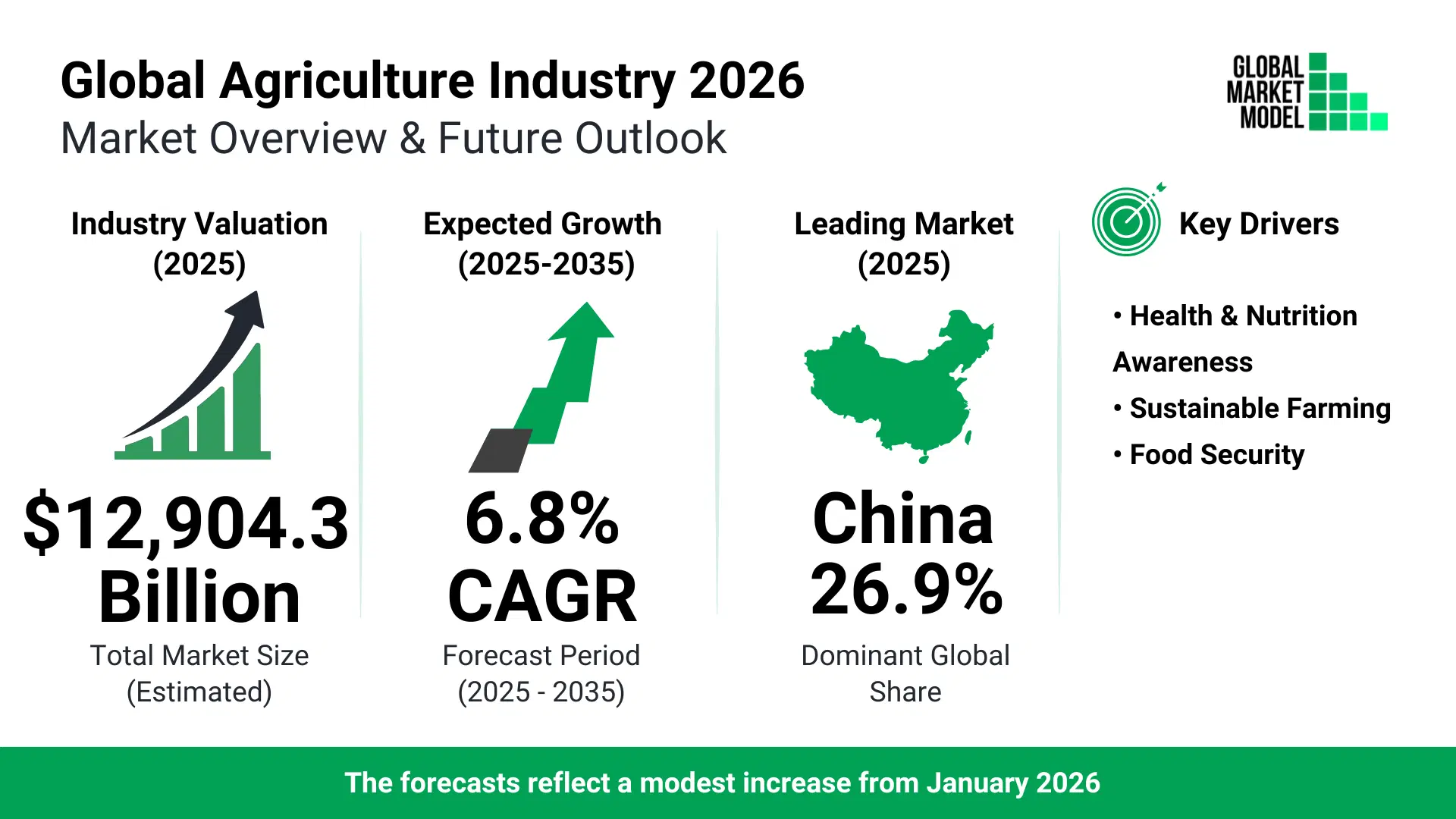
According to the latest Global Market Model forecast, the global agriculture market was valued at $12,904.3 billion in 2025 and is projected to expand at a CAGR of 6.8% between 2025 and 2035. Rising global food demand, changing dietary preferences, and continued investment in agricultural technology are expected to support steady long-term growth across crop production, livestock farming, and agri-input markets.
Why Is the Global Agriculture Market Growing?
The agriculture industry is undergoing rapid transformation as governments, producers, and agribusinesses focus on improving productivity while ensuring long-term sustainability. Several structural trends are driving market expansion, including:
- Growing global population and food consumption
- Rising demand for healthier diets rich in fruits, vegetables, and whole grains
- Expansion of organic and regenerative farming practices
- Increased adoption of precision agriculture and smart farming technologies
- Government initiatives supporting food security and domestic agricultural production
These trends are encouraging greater investment across the agricultural value chain while improving production efficiency.
Crop Production Continues to Lead the Agriculture Industry
Agriculture remains one of the world's most important economic sectors, accounting for 10.9% of global GDP in 2025, with annual per capita spending reaching $1,606.
Among all agricultural activities, crop production represented 40.9% of the global market in 2025, supported by:
- Strong demand for premium agricultural products
- Rising consumption of plant-based and protein-rich foods
- Higher disposable incomes in emerging economies
- Favorable government policies promoting agricultural output
- Continued expansion of commercial farming operations
Regional Analysis: China Remains the World's Largest Agriculture Market
China accounted for 26.9% of the global agriculture market in 2025, reflecting its extensive farming sector, large domestic food demand, and ongoing investments in agricultural modernization.
Many emerging economies are also increasing investments in irrigation infrastructure, mechanization, digital agriculture, and climate-resilient farming practices to improve productivity and reduce supply risks.
Agriculture Outlook: Technology and Sustainability Support Long-Term Market Growth
The July 2026 forecast indicates a modest improvement compared with previous projections despite ongoing geopolitical and trade uncertainties.
Key developments influencing the market include:
- Greater focus on national food security strategies
- Expansion of precision agriculture, AI-enabled farm management, and satellite monitoring
- Increased investment in efficient irrigation and water conservation
- Adoption of climate-smart farming techniques
- Strong commodity demand supporting agricultural incomes
Although trade policies and geopolitical tensions continue to affect global supply chains, long-term fundamentals remain positive as governments prioritize resilient food production systems and sustainable agriculture.
The Global Market Model provides comprehensive market intelligence covering critical agricultural indicators, including:
- Arable land
- Livestock population
- Poultry population
- Area cultivated for grains
- Area cultivated for oilseeds
- Area cultivated for vegetables
- Area cultivated for fruits
- Number of enterprises
- Number of employees
Explore detailed agriculture market forecasts, regional opportunities, production trends, and industry benchmarks with the Global Market Model.Request a Demo
The Global Market Model is the world's largest database of market forecasts. Forecasts for over 30,000 markets are updated semi-annually on the basis of economic, geo-political and sector-specific factors. The current forecast was made in July 2026, revising the previous forecasts made in January 2026.
The world's most comprehensive database
- For further information and inquiries:
Global Market Model - Europe: +44 788 2955 267
- Asia: +44 788 2955 267 & +91 88972 63534
- America: +1 310 496 7795
Chemicals Market Forecast 2025–2035: Specialty Chemicals, Sustainable Manufacturing, and Industrial Innovation Drive Future Growth
Global Chemicals Market Size and Growth Outlook Through 2035
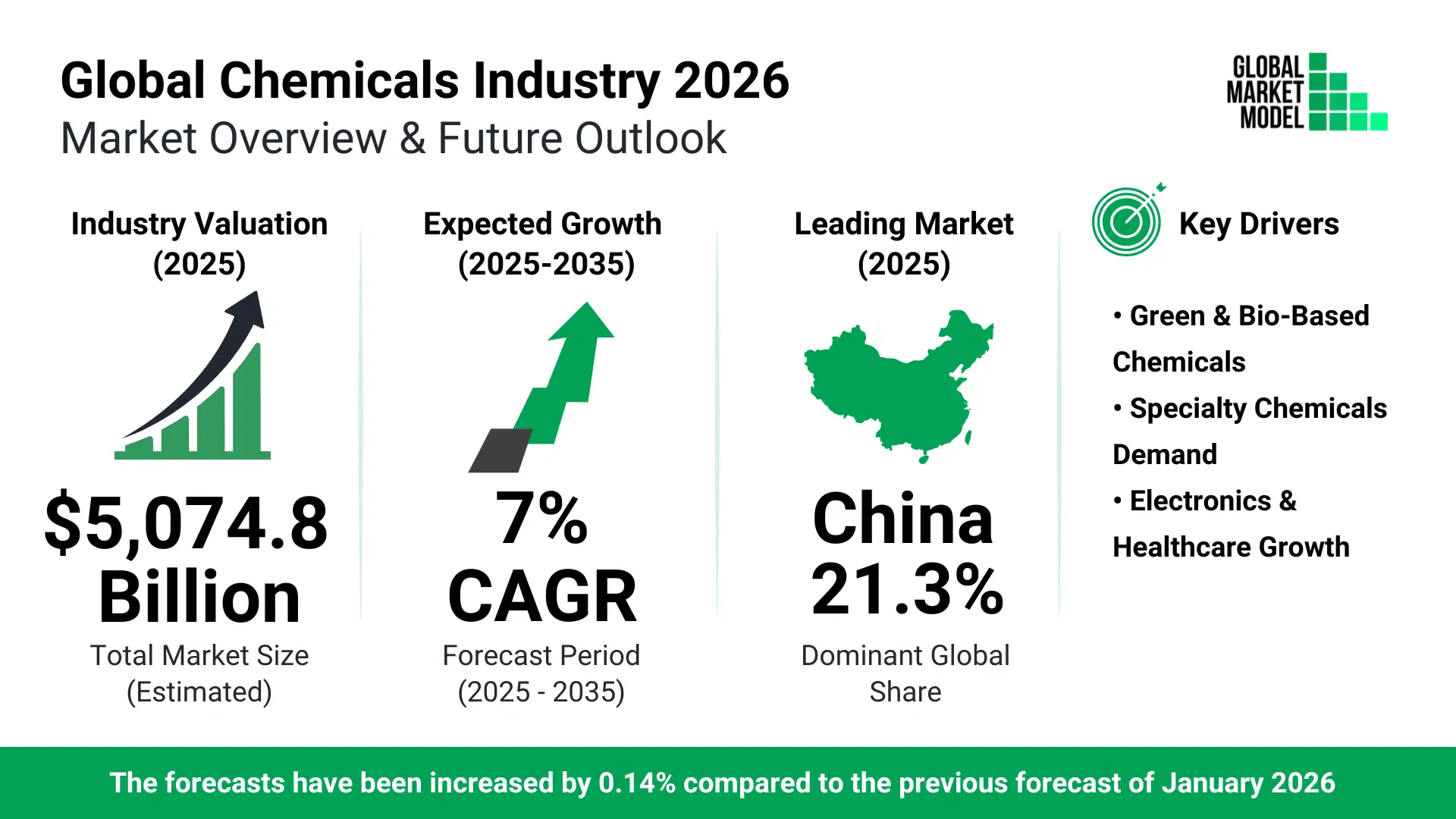
According to the latest Global Market Model forecast, the global chemicals market was valued at $6,237.4 billion in 2025 and is expected to grow steadily through 2035 as demand increases across manufacturing, construction, automotive, healthcare, agriculture, and consumer goods industries. Continuous innovation and the transition toward sustainable chemical production are expected to remain major growth catalysts over the forecast period.
What's Fueling Growth in the Global Chemicals Market?
The chemicals industry is evolving rapidly as manufacturers balance rising industrial demand with increasing sustainability requirements. Several long-term factors are supporting market expansion:
- Growing demand for specialty and performance chemicals
- Expansion of manufacturing activities across emerging economies
- Rising investments in green chemistry and low-carbon production processes
- Increasing use of chemicals in electric vehicles, batteries, and renewable energy technologies
- Higher consumption from pharmaceuticals, electronics, agriculture, and construction industries
- Advancements in chemical recycling and circular economy initiatives
These trends are encouraging chemical producers to invest in innovation, process efficiency, and environmentally responsible manufacturing.
Specialty Chemicals Continue to Outperform Commodity Segments
While commodity chemicals remain essential to global manufacturing, specialty chemicals are becoming an increasingly important source of value creation. Industries such as healthcare, electronics, coatings, water treatment, and advanced materials are driving demand for high-performance chemical products that offer improved functionality and sustainability.
Manufacturers are also focusing on product differentiation, digital manufacturing, and advanced process automation to improve operational efficiency and maintain competitiveness in a changing regulatory environment.
Asia-Pacific Remains the Center of Global Chemical Production
Asia-Pacific continues to dominate global chemical manufacturing, led by China, which benefits from extensive production capacity, integrated supply chains, and strong domestic demand. The region is also attracting significant investment in petrochemicals, specialty chemicals, and advanced materials.
Meanwhile, North America and Europe continue to strengthen their positions through innovation in sustainable chemistry, bio-based materials, and high-value specialty chemical production.
Sustainability and Supply Chain Resilience Are Reshaping the Chemicals Industry
The July 2026 forecast reflects a resilient outlook despite ongoing geopolitical uncertainties and fluctuations in raw material prices.
Key industry developments include:
- Accelerating adoption of low-emission production technologies
- Increased investment in bio-based and renewable feedstocks
- Greater emphasis on chemical recycling and waste reduction
- Digital transformation of manufacturing facilities through AI and automation
- Diversification of global supply chains to improve resilience
As environmental regulations continue to evolve worldwide, chemical manufacturers are prioritizing sustainable operations while expanding capacity to meet growing industrial demand.
The Global Market Model provides comprehensive intelligence across the chemicals industry, including:
- Country-level market forecasts
- Historical and forecast market values
- Production and consumption trends
- Number of enterprises
- Number of employees
- Industry-specific economic indicators
- Market growth drivers and long-term forecasts
Want deeper insights into the global chemicals market, country-level forecasts, and industry benchmarks?Request a Demo
The Global Market Model is the world's largest database of market forecasts. Forecasts for over 30,000 markets are updated semi-annually on the basis of economic, geo-political and sector-specific factors. The current forecast was made in July 2026, revising the previous forecasts made in January 2026.
The world's most comprehensive database
- For further information and inquiries:
Global Market Model - Europe: +44 788 2955 267
- Asia: +44 788 2955 267 & +91 88972 63534
- America: +1 310 496 7795
Construction Market Size Was $19,519.3 Billion In 2025: Forecast, Growth Drivers and Industry Outlook Through 2035
Global Construction Market Forecast Signals Continued Expansion Through 2035
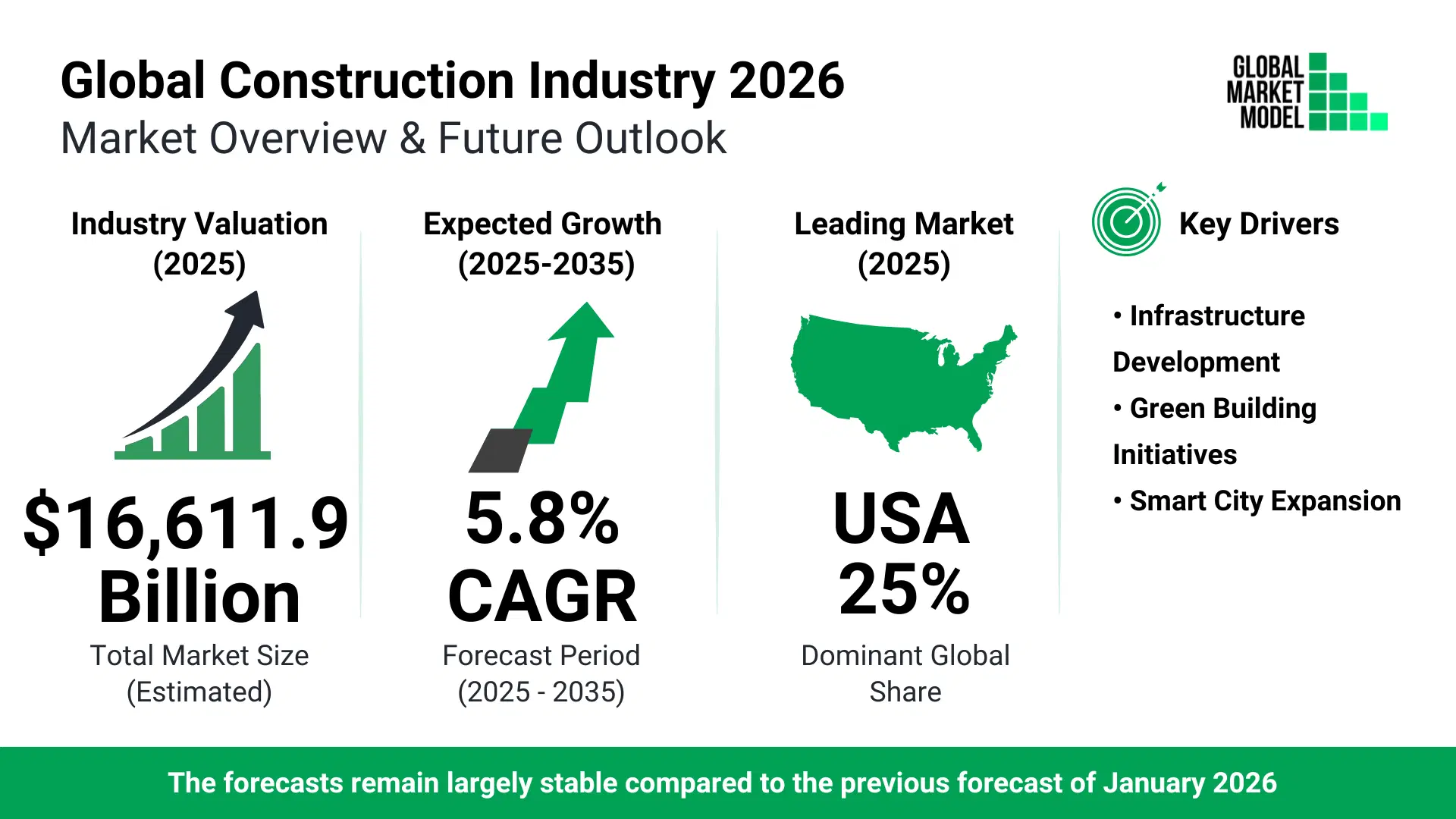
According to the latest Global Market Model forecast, the global construction market reached $19,519.3 billion in 2025 and is expected to maintain strong momentum through 2035. Population growth, urban expansion, infrastructure modernization, and increasing investment in sustainable development are creating significant opportunities across residential, commercial, industrial, and civil engineering projects worldwide.
As governments prioritize economic development and climate resilience, construction activity is expanding beyond traditional infrastructure into smart cities, renewable energy facilities, and digital infrastructure.
What Is Driving Growth in the Global Construction Market?
The construction industry is benefiting from multiple long-term economic and demographic trends that continue to increase demand for new infrastructure and buildings.
Some of the major growth drivers include:
- Rising public investment in transportation and utility infrastructure
- Rapid urbanization across emerging economies
- Growing demand for residential housing and commercial real estate
- Expansion of renewable energy and industrial construction projects
- Increasing adoption of green building standards and sustainable construction materials
- Digital transformation through Building Information Modeling (BIM), AI, robotics, and construction management software
Together, these trends are improving project efficiency while creating new opportunities across the global construction value chain.
Infrastructure Projects Continue to Generate the Largest Construction Opportunities
Infrastructure development remains one of the strongest contributors to construction market growth. Governments around the world are investing heavily in highways, railways, airports, ports, water infrastructure, power transmission networks, and smart city developments to support long-term economic growth.
At the same time, demand for residential and commercial construction continues to increase as expanding urban populations require modern housing, office buildings, healthcare facilities, educational institutions, and logistics infrastructure.
The growing use of modular construction, prefabrication, and advanced construction technologies is also helping contractors reduce costs, improve productivity, and accelerate project delivery.
Asia-Pacific Remains the World's Largest Construction Market
Asia-Pacific continues to dominate global construction activity, driven by large-scale infrastructure investments and rapid urban development.
China remains one of the largest contributors to global construction output, while countries such as India, Indonesia, and Vietnam continue investing in transportation networks, industrial corridors, renewable energy projects, and affordable housing initiatives.
Meanwhile, North America and Europe are increasingly focusing on upgrading aging infrastructure, improving energy efficiency, and developing resilient buildings designed to meet evolving environmental regulations.
Sustainability and Digital Innovation Are Reshaping the Construction Industry
The July 2026 Global Market Model forecast highlights continued optimism for the construction sector despite inflationary pressures and supply chain challenges experienced in recent years.
Several trends are expected to define the industry's future:
- Greater adoption of low-carbon construction materials
- Expansion of net-zero and energy-efficient buildings
- Increased implementation of AI, drones, robotics, and digital twins
- Wider adoption of BIM across project lifecycles
- Strong investment in climate-resilient infrastructure and disaster mitigation projects
As environmental regulations become more stringent and labour shortages persist, construction companies are increasingly adopting technology-driven solutions that improve productivity while supporting sustainable development goals.
The Global Market Model provides comprehensive construction market intelligence covering:
- Number of households
- Construction spending
- Number of new households
- Number of enterprises
- Number of employees
These insights help businesses evaluate market potential, identify investment opportunities, and support strategic decision-making.
Want deeper insights into the global construction market, country-level forecasts, and industry benchmarks?Request a Demo
The Global Market Model is the world's largest database of market forecasts. Forecasts for over 30,000 markets are updated semi-annually on the basis of economic, geo-political and sector-specific factors. The current forecast was made in July 2026, revising the previous forecasts made in January 2026.
The world's most comprehensive database
- For further information and inquiries:
Global Market Model - Europe: +44 788 2955 267
- Asia: +44 788 2955 267 & +91 88972 63534
- America: +1 310 496 7795
Electrical and Electronics Market Size Was $4,106.1 Billion In 2025: Forecast, Growth Drivers and Industry Outlook Through 2035
Global Electrical and Electronics Market Forecast Highlights Strong Growth Through 2035
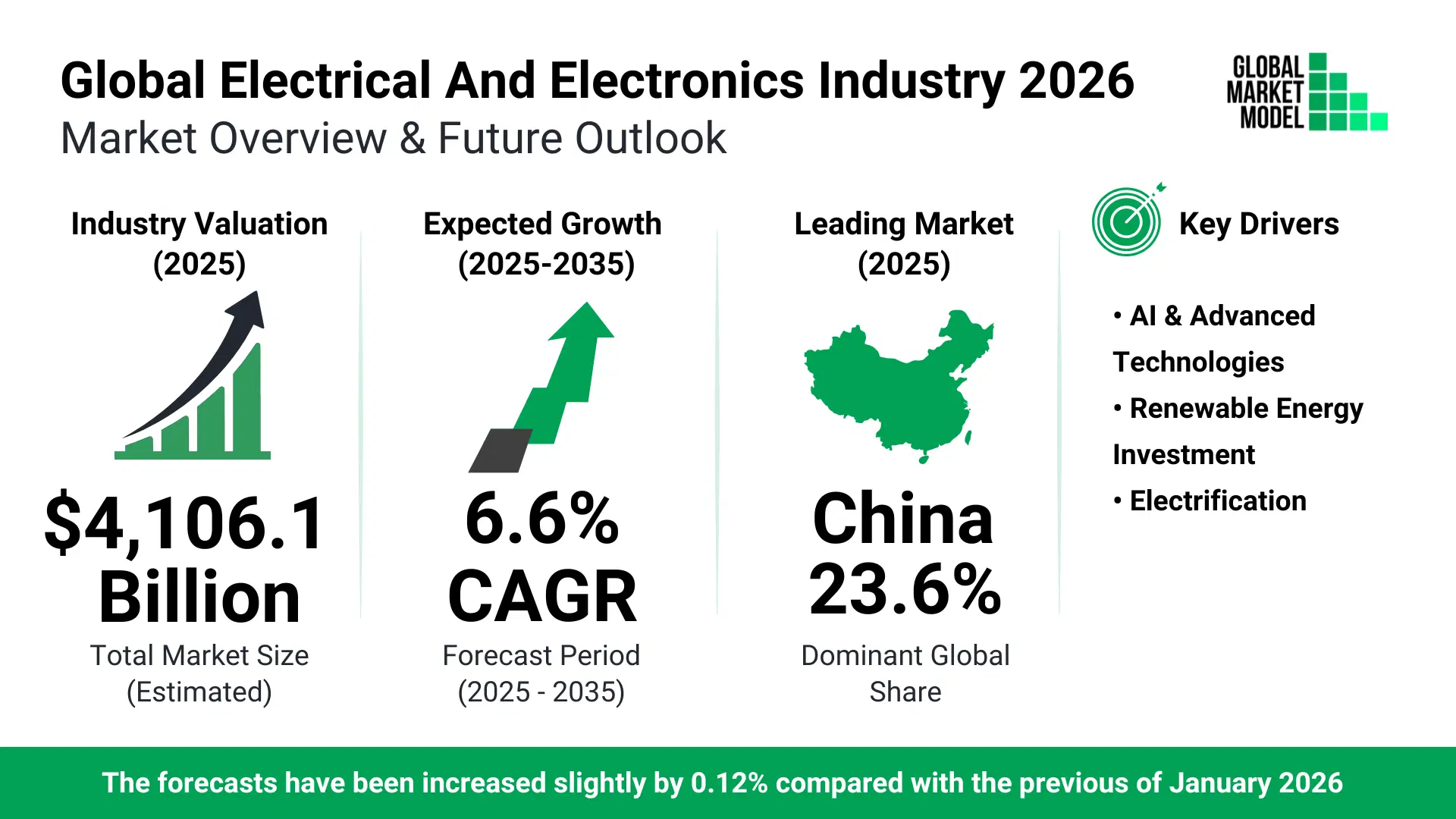
According to the latest Global Market Model forecast, the global electrical and electronics market reached $4,106.1 billion in 2025 and is projected to grow at a compound annual growth rate (CAGR) of 6.6% from 2025 to 2035. The market is entering a new phase of growth, supported by rapid digital transformation, accelerating electrification across industries, and increasing demand for intelligent connected devices.
Emerging technologies such as artificial intelligence (AI), the Internet of Things (IoT), 5G communications, advanced sensors, and virtual reality are reshaping the industry, while investments in electric vehicles, renewable energy, and industrial automation continue to create new opportunities for manufacturers worldwide.
Why Is the Electrical and Electronics Market Growing?
The electrical and electronics industry sits at the center of global technological innovation. As businesses and consumers adopt smarter, more connected technologies, demand for advanced electronic components and electrical equipment continues to rise.
Key market drivers include:
- Growing investment in AI infrastructure and high-performance computing
- Rapid expansion of electric vehicle production
- Rising deployment of renewable energy systems and grid modernization projects
- Increasing adoption of smart home technologies and connected consumer devices
- Growth in industrial automation and Industry 4.0 initiatives
- Expanding global demand for semiconductors, sensors, batteries, and power electronics
Together, these trends are driving sustained investment across both consumer electronics and industrial electrical equipment markets.
Electrical Equipment Continues to Dominate the Industry
The electrical equipment segment accounted for 43.1% of the global electrical and electronics market in 2025, making it the largest segment within the industry.
The overall market represented 3.5% of global GDP in 2025, with annual per capita spending reaching $511.01.
Demand remains particularly strong for:
- Electrical transmission and distribution equipment
- Batteries and energy storage systems
- Power electronics supporting renewable energy integration
- Industrial automation equipment
- Semiconductor manufacturing technologies
- Smart consumer electronics
As electrification accelerates across transportation, manufacturing, and infrastructure, electrical equipment manufacturers are expected to remain key beneficiaries of long-term market growth.
China Continues to Lead Global Electrical and Electronics Manufacturing
China accounted for 23.6% of the global electrical and electronics market in 2025, supported by its extensive manufacturing ecosystem, mature electronics supply chains, and strong domestic demand.
The country continues to play a central role in global production of semiconductors, consumer electronics, electrical equipment, batteries, and industrial components. Meanwhile, other Asia-Pacific economies are expanding manufacturing capacity to strengthen regional supply chains and meet growing international demand.
AI Infrastructure and Electrification Are Driving a Stronger Market Outlook
The July 2026 Global Market Model forecast has revised market expectations upward by 0.12% compared with the previous forecast.
The upward revision reflects stronger-than-expected demand across several high-growth areas, including:
- AI infrastructure, including GPUs, servers, and data center equipment
- Advanced semiconductor manufacturing
- Electric vehicles and battery technologies
- Renewable energy infrastructure
- Smart devices and connected electronics
- Industrial automation and digital manufacturing
The industry has also benefited from gradual improvements in component availability and logistics, helping manufacturers reduce production bottlenecks experienced in recent years.
However, challenges remain. Elevated raw material costs, manufacturing capacity constraints, trade restrictions, export controls, and geopolitical tensions have continued to create uncertainty across global supply chains. Despite these pressures, sustained investment in digital transformation and electrification has outweighed short-term headwinds, reinforcing positive long-term market growth.
The Global Market Model provides comprehensive market intelligence covering the electrical and electronics industry, including:
- Number of enterprises
- Number of employees
These insights enable manufacturers, investors, consultants, and policymakers to identify emerging opportunities and benchmark performance across global markets.
Want deeper insights into the global electrical and electronics market, country-level forecasts, and industry benchmarks?Request a Demo
The Global Market Model is the world's largest database of market forecasts. Forecasts for over 30,000 markets are updated semi-annually on the basis of economic, geo-political and sector-specific factors. The current forecast was made in July 2026, revising the previous forecasts made in January 2026.
The world's most comprehensive database
- For further information and inquiries:
Global Market Model - Europe: +44 788 2955 267
- Asia: +44 788 2955 267 & +91 88972 63534
- America: +1 310 496 7795
Financial Services Market Growth Fueled by Alternative Investments, Digital Payments, and AI-Driven Banking
Global Financial Services Market Forecast Shows Strong Momentum Through 2035
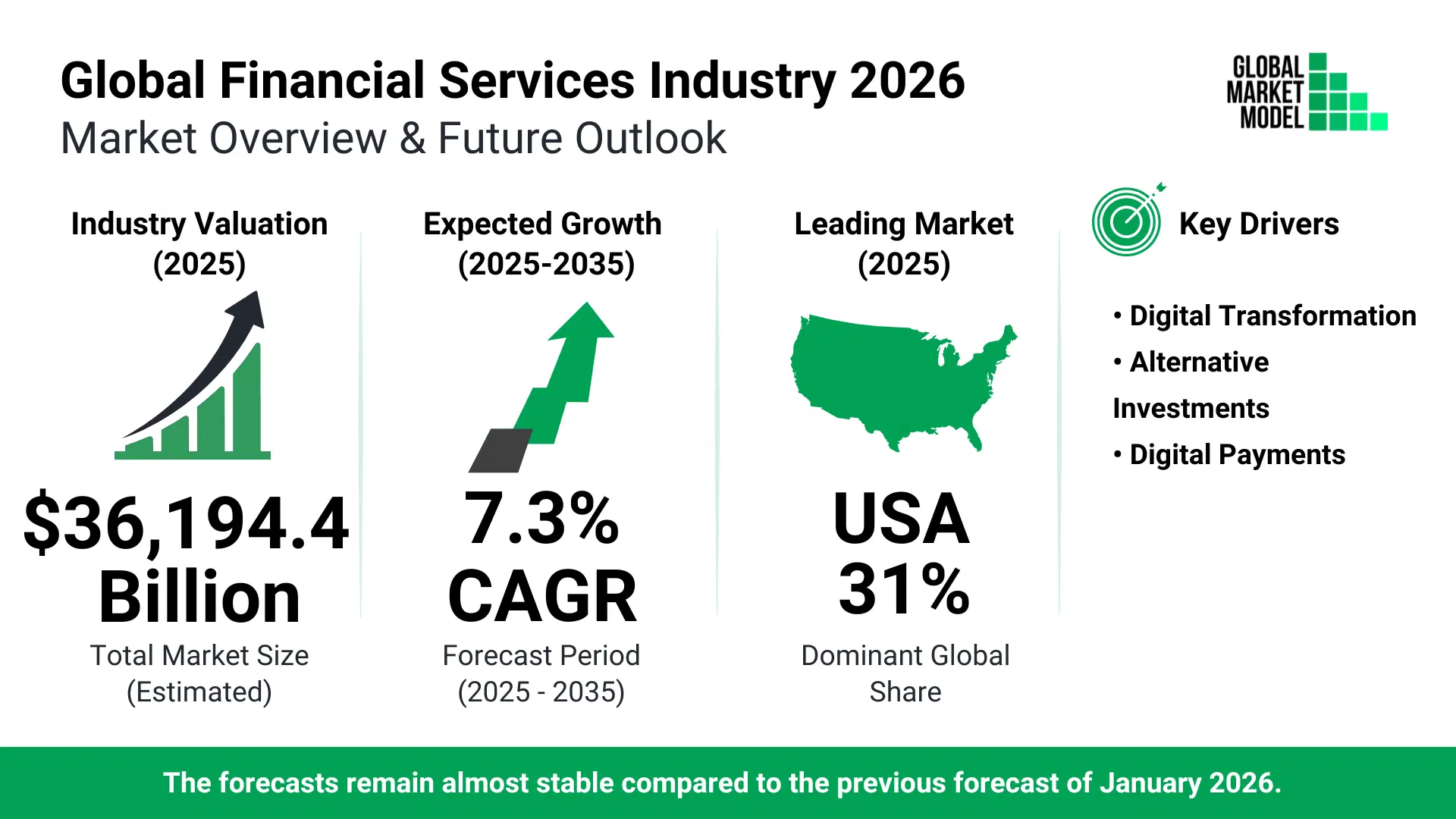
According to the latest Global Market Model forecast, the global financial services market was valued at $36,194.4 billion in 2025 and is projected to grow at a compound annual growth rate (CAGR) of 7.3% from 2025 to 2035. The market continues to evolve as financial institutions embrace digital technologies, diversify investment products, and modernize payment infrastructure to meet changing customer expectations.
The increasing use of artificial intelligence, blockchain, and embedded finance is reshaping financial services, enabling institutions to improve operational efficiency, strengthen security, and deliver more personalized customer experiences.
What's Driving Growth in the Global Financial Services Market?
The financial services industry is undergoing one of its most significant transformations in decades, driven by innovation, changing consumer behaviour, and expanding access to financial products.
Some of the key factors supporting market growth include:
- Rising global wealth and increasing investor participation in alternative asset classes
- Rapid expansion of digital payments and real-time payment infrastructure
- Growing adoption of artificial intelligence for financial planning, fraud detection, and customer engagement
- Increasing use of blockchain technology to improve transaction security and transparency
- Expansion of digital banking, mobile wallets, and embedded financial services
- Continued efforts to improve financial inclusion across emerging economies
These trends are helping financial institutions improve customer access while creating new revenue opportunities across banking, insurance, lending, payments, and investment services.
Lending and Payments Continue to Dominate the Financial Services Industry
The lending and payments segment accounted for 36.7% of the global financial services market in 2025, making it the largest segment within the industry.
Overall, the sector represented 30.7% of global GDP in 2025, highlighting its central role in supporting economic activity, business investment, and consumer spending worldwide.
The insurance segment also continues to expand steadily, supported by:
- Rising healthcare expenditure in developed economies
- Aging populations across Europe and Japan
- Growing middle-class populations in countries such as China and India
- Increasing awareness of health, life, and property insurance products
Meanwhile, digital lending platforms, insurtech solutions, and wealth management technologies are broadening access to financial services across both developed and emerging markets.
The United States Remains the World's Largest Financial Services Market
The United States accounted for 31% of the global financial services market in 2025, supported by its mature banking system, advanced capital markets, strong fintech ecosystem, and extensive institutional investment landscape.
Other major economies are also accelerating investment in open banking, digital identity, instant payment systems, and financial technology to improve customer experience and expand financial inclusion.
Digital Innovation Continues to Support a Stable Market Outlook
The July 2026 Global Market Model forecast remains largely stable compared with the previous forecast, reflecting the resilience of the financial services sector despite macroeconomic uncertainty and geopolitical challenges.
Recent market developments include:
- Financial institutions adapting to evolving regulatory frameworks and monetary policies
- Increased oversight of fintech companies, digital lending platforms, and cryptocurrency services
- Continued investment in AI-powered risk management and fraud prevention
- Expansion of real-time payment systems and digital banking infrastructure
- Ongoing initiatives to improve financial access in underserved markets
Although geopolitical tensions, including the Iran-Israel conflict and continued instability in Eastern Europe, have contributed to volatility in foreign exchange markets and cross-border capital flows, the long-term outlook remains positive. Strong digital infrastructure, payment modernization, and continued innovation across financial technology continue to support sustainable market growth.
The Global Market Model provides detailed financial services market intelligence, including:
- Number of enterprises
- Number of employees
These insights help banks, insurers, fintech companies, investors, consultants, and policymakers identify emerging opportunities, benchmark performance, and make informed strategic decisions.
Want deeper insights into the global financial services market, country-level forecasts, and industry benchmarks?Request a Demo
The Global Market Model is the world's largest database of market forecasts. Forecasts for over 30,000 markets are updated semi-annually on the basis of economic, geo-political and sector-specific factors. The current forecast was made in July 2026, revising the previous forecasts made in January 2026.
The world's most comprehensive database
- For further information and inquiries:
Global Market Model - Europe: +44 788 2955 267
- Asia: +44 788 2955 267 & +91 88972 63534
- America: +1 310 496 7795
Food and Beverage Market Growth Driven by Health-Conscious Consumers, Convenience Foods, and Plant-Based Innovation
Global Food and Beverage Market Forecast Shows Steady Growth Through 2035
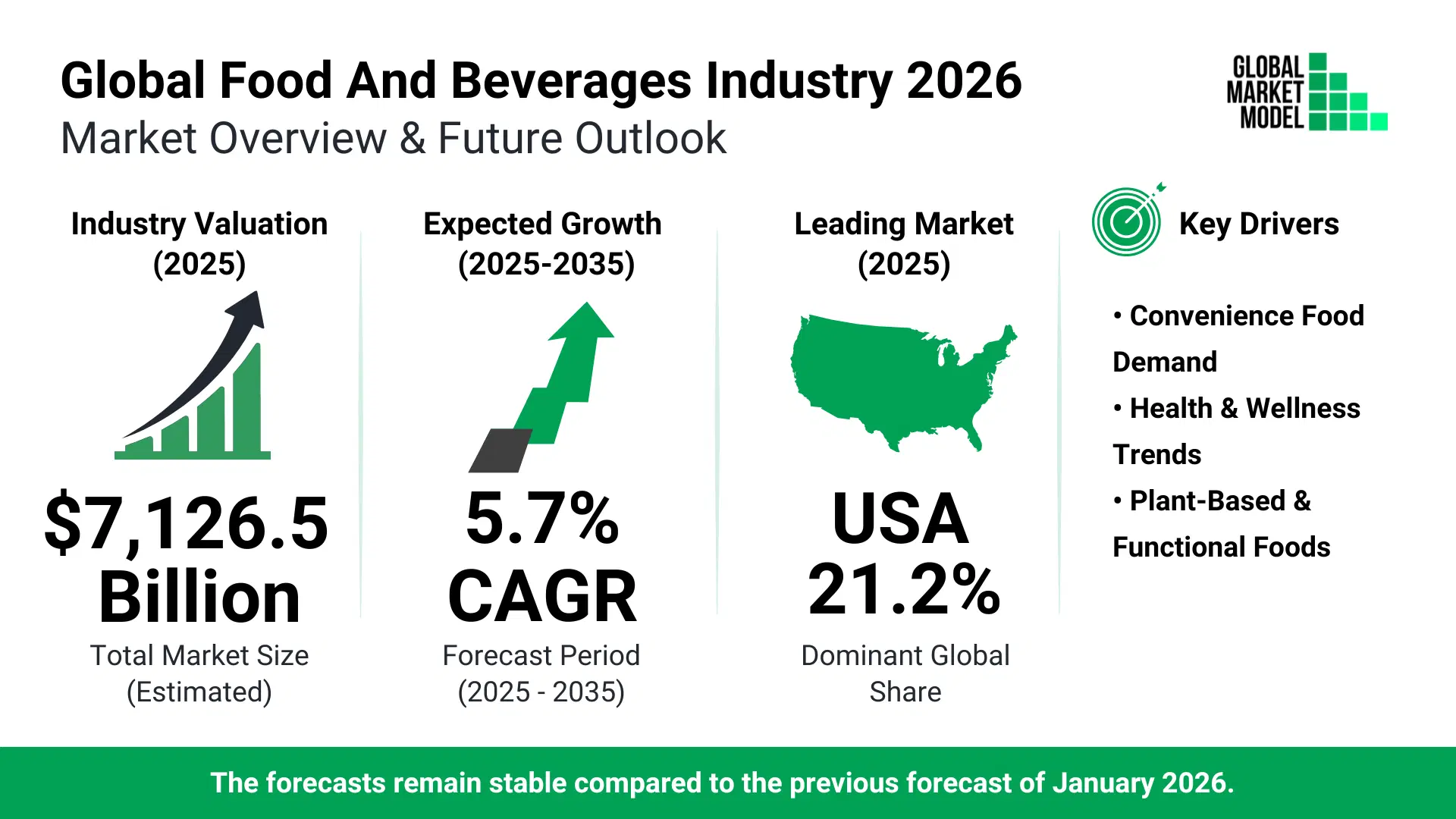
According to the latest Global Market Model forecast, the global food and beverage market was valued at $7,126.5 billion in 2025 and is projected to grow at a compound annual growth rate (CAGR) of 5.7% between 2025 and 2035. Consumer demand is increasingly shifting toward healthier, more convenient, and sustainably produced food products, encouraging manufacturers to innovate across product development, packaging, and food processing technologies.
The growing popularity of functional foods, plant-based alternatives, and advanced preservation techniques is reshaping the global food industry while creating new growth opportunities across retail and foodservice channels.
What's Driving Growth in the Global Food and Beverage Market?
Changing lifestyles, rising disposable incomes, and greater health awareness continue to influence food purchasing decisions worldwide. Consumers are increasingly seeking products that combine convenience with nutrition, prompting manufacturers to expand premium and value-added product offerings.
Key growth drivers include:
- Rising demand for convenience and ready-to-eat foods
- Growing consumer preference for organic and plant-based products
- Increasing popularity of vegan, functional, and fortified foods
- Advancements in food preservation and packaging technologies
- Wider adoption of Individual Quick Freezing (IQF) technologies
- Expanding urban populations and changing dietary habits
These trends are driving innovation across product categories while encouraging investment in sustainable sourcing, food safety, and production efficiency.
Meat, Poultry, and Seafood Continue to Lead the Market
The meat, poultry, and seafood segment accounted for 23.2% of the global food and beverage market in 2025, making it the industry's largest segment.
Overall, the sector represented 6.0% of global GDP in 2025, with annual per capita expenditure reaching $886.92.
Demand remains strong due to:
- Growing protein consumption
- Rising fitness and wellness awareness
- Government-supported nutrition initiatives
- Continued demand for convenient, high-protein meal options
At the same time, manufacturers are expanding their portfolios of plant-based proteins and alternative food products to meet evolving consumer preferences.
The United States Remains the Largest Food and Beverage Market
The United States accounted for 21.2% of the global food and beverage market in 2025, supported by high consumer spending, advanced food manufacturing capabilities, and strong demand for packaged, frozen, and convenience food products.
Across both developed and emerging markets, food companies are investing in healthier formulations, sustainable ingredients, digital supply chains, and innovative processing technologies to improve product quality and meet changing consumer expectations.
Innovation and Consumer Demand Continue to Support a Stable Market Outlook
The July 2026 Global Market Model forecast remains largely stable compared with the previous forecast, reflecting the sector's resilience despite supply chain disruptions and geopolitical uncertainty.
Recent developments shaping the market include:
- Continued innovation in plant-based, vegan, and functional food products
- Improvements in sourcing, processing, and cold-chain logistics
- Rising consumer demand for nutritious, shelf-stable, and convenient food options
- Increasing investment in sustainable food production and packaging
- Growing adoption of advanced food preservation technologies, including IQF
Although adverse weather conditions, supply chain disruptions, trade policy developments, and geopolitical tensions such as the Iran-Israel conflict have increased input, energy, and transportation costs, long-term demand fundamentals remain strong. Ongoing product innovation and changing consumer lifestyles continue to reinforce the industry's positive growth outlook.
The Global Market Model provides comprehensive food and beverage market intelligence, including:
- Number of enterprises
- Number of employees
- Livestock primary meat
These insights help food manufacturers, retailers, investors, distributors, and policymakers evaluate emerging opportunities, benchmark performance, and make informed strategic decisions.
Want deeper insights into the global food and beverage market, country-level forecasts, and industry benchmarks?Request a Demo
The Global Market Model is the world's largest database of market forecasts. Forecasts for over 30,000 markets are updated semi-annually on the basis of economic, geo-political and sector-specific factors. The current forecast was made in July 2026, revising the previous forecasts made in January 2026.
The world's most comprehensive database
- For further information and inquiries:
Global Market Model - Europe: +44 788 2955 267
- Asia: +44 788 2955 267 & +91 88972 63534
- America: +1 310 496 7795
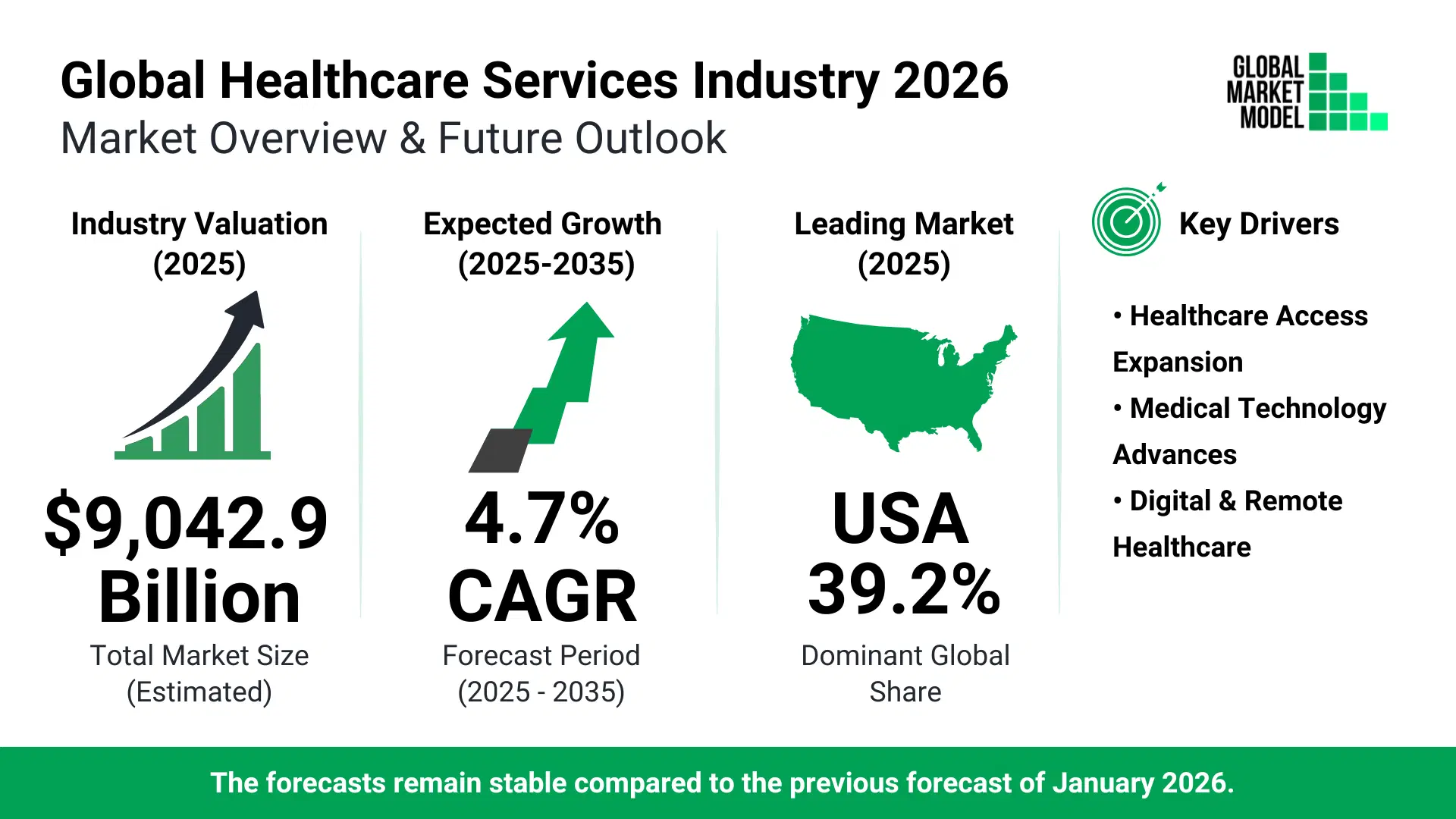
Healthcare Services Market Valued at $9,042.9 Billion in 2025, Projected to Grow at a 4.7% CAGR Through 2035
Global Healthcare Services Market Forecast Shows Steady Growth Through 2035
According to the latest Global Market Model forecast, the global healthcare services market was valued at $9,042.9 billion in 2025 and is projected to grow at a compound annual growth rate (CAGR) of 4.7% from 2025 to 2035. Growth during the forecast period is expected to be supported by technological advancements in diagnostic and therapeutic equipment, increasing healthcare access, rising medical tourism, improvements in survival rates and quality of life, and lifestyle changes associated with more sedentary occupations.
What's Driving Growth in the Global Healthcare Services Market?
The healthcare services sector continues to evolve as healthcare systems expand access to care while adopting new technologies to improve patient outcomes and operational efficiency.
Key growth drivers include:
- Technological advancements in diagnostic and therapeutic equipment
- Increasing healthcare access across developed and emerging economies
- Rising demand for medical tourism
- Improvements in survival rates and quality of life
- Lifestyle changes and an increase in sedentary jobs contributing to higher healthcare demand
These factors continue to strengthen demand for healthcare services across hospitals, outpatient facilities, diagnostic centers, and specialized care providers.
Hospitals and Outpatient Care Centers Remain the Largest Market Segment
The hospitals and outpatient care centers segment accounted for 53.4% of the global healthcare services market in 2025, making it the largest segment within the industry.
Overall, the healthcare services market represented 7.7% of global GDP in 2025, with per capita consumption reaching $1,125.42 per person per annum.
The market continues to benefit from:
- Technological advances that improve the affordability and accessibility of healthcare services
- High per-capita income and healthcare expenditure in developed countries
- Government initiatives to improve healthcare delivery
- Rising prevalence of age-related diseases such as Alzheimer's and Parkinson's disease
The United States Remains the Largest Healthcare Services Market
The United States accounted for 39.2% of the global healthcare services market in 2025, supported by high healthcare expenditure, advanced healthcare infrastructure, and continued investment in medical innovation.
Healthcare systems across developed and emerging markets continue to expand access to quality care while investing in digital health technologies and more efficient models of service delivery.
Digital Healthcare and Policy Initiatives Support a Stable Market Outlook
The July 2026 Global Market Model forecast remains largely stable compared with the previous forecast.
Over the past six months, healthcare consumption has been influenced by workforce shortages and rising labour costs, resulting in service capacity constraints and longer waiting times in several regions. In response, governments have expanded preventive care budgets and revised reimbursement frameworks. In the United States, Medicare reforms have strengthened telehealth coverage and promoted value-based care.
Health systems in the UK and across Southeast Asia have also increased investment in AI-enabled diagnostics and initiatives designed to improve clinical efficiency, accelerating the transition toward more technology-driven healthcare delivery.
Although geopolitical tensions, including the Iran-Israel conflict, have contributed to higher energy prices and disruptions in medical supply logistics, creating additional cost pressures for healthcare providers, long-term demand remains supported by aging populations, sustained policy investments, and the growing adoption of digital and remote healthcare solutions.
The Global Market Model provides detailed healthcare services market intelligence, including:
- Asthma prevalence rate
- Cancer prevalence rate
- Cerebrovascular prevalence rate
- Dermatitis prevalence rate
- Healthcare expenditure
- Hearing loss prevalence rate
- HIV prevalence rate
- Diabetes prevalence rate
- Glaucoma prevalence rate
- Healthcare - number of employees
- Healthcare - number of enterprises
- Hospital beds
- Hypertension prevalence rate
- Number of dentists
Want deeper insights into the global healthcare services market, country-level forecasts, and industry benchmarks?Request a Demo
The Global Market Model is the world's largest database of market forecasts. Forecasts for over 30,000 markets are updated semi-annually on the basis of economic, geo-political and sector-specific factors. The current forecast was made in July 2026, revising the previous forecasts made in January 2026.
The world's most comprehensive database
- For further information and inquiries:
Global Market Model - Europe: +44 788 2955 267
- Asia: +44 788 2955 267 & +91 88972 63534
- America: +1 310 496 7795
Hospitality Market Growth Driven by Experiential Travel, Global Mobility, and Smart Hospitality Solutions
Global Hospitality Market Forecast Signals Steady Growth Through 2035
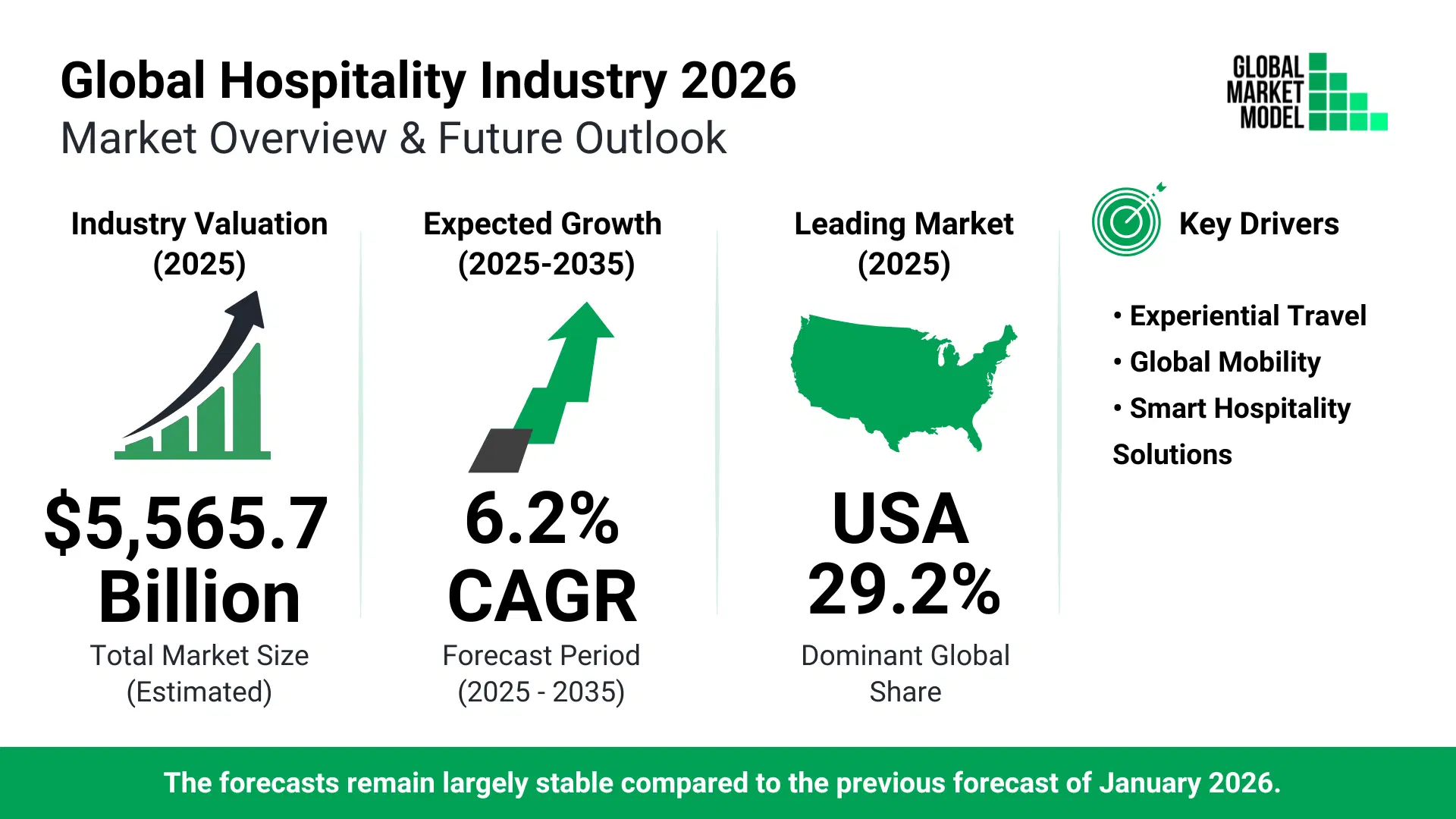
According to the latest Global Market Model forecast, the global hospitality market was valued at $5,565.7 billion in 2025 and is projected to grow at a compound annual growth rate (CAGR) of 6.2% from 2025 to 2035. The market continues to benefit from changing travel patterns, rising global mobility, and increasing consumer demand for personalized and technology-enabled hospitality experiences.
Growth is being supported by a rise in solo and experiential travel, easing visa requirements across multiple regions, and increasing international travel for work and education.
What's Driving Growth in the Global Hospitality Market?
Consumer expectations are evolving beyond traditional accommodation and dining, encouraging hospitality businesses to invest in more personalized, flexible, and digitally connected experiences.
Key growth drivers include:
- Rising demand for solo and experiential travel
- Continued easing of visa requirements across multiple countries
- Increasing global mobility for work and higher education
- Growing preference for personalized travel experiences
- Expansion of digital booking platforms and mobile travel services
- Rising demand for convenience foods and seamless guest experiences
These trends are encouraging hotels, restaurants, and hospitality providers to enhance service offerings while adopting technologies that improve operational efficiency and customer engagement.
Food and Beverage Services Continue to Lead the Hospitality Market
The food and beverage services segment accounted for 73.7% of the global hospitality market in 2025, making it the industry's largest segment.
Overall, the hospitality sector represented 4.7% of global GDP in 2025, with per capita consumption reaching $692.68 per person per annum.
Demand continues to be supported by:
- Strong domestic and regional tourism
- Growing preference for flexible and affordable accommodation options
- Rising popularity of hostels, mid-scale hotels, and alternative lodging
- Increasing consumer spending on dining and leisure experiences
These factors continue to strengthen demand across both accommodation and foodservice businesses.
The United States Remains the Largest Hospitality Market
The United States accounted for 29.2% of the global hospitality market in 2025, supported by strong domestic travel, a mature tourism industry, and high consumer spending across hotels, restaurants, and entertainment venues.
Meanwhile, emerging economies continue to experience growing hospitality demand as rising incomes, expanding tourism infrastructure, and improving connectivity encourage greater domestic and international travel.
Smart Hospitality Technologies Continue to Support Market Stability
The July 2026 Global Market Model forecast remains largely stable compared with the previous forecast.
Over the past six months, hospitality businesses have faced increasing costs related to wages, food inputs, and utilities, placing pressure on operating margins. However, strong domestic leisure travel, event-driven tourism, and growing urban social activity have helped sustain occupancy levels and customer traffic despite a gradual recovery in international and corporate travel.
To improve efficiency and enhance guest experiences, hospitality providers are increasingly investing in AI-powered revenue management systems, automated check-in technologies, and digital customer engagement platforms. These operational improvements, together with continued demand for travel, dining, and social experiences, support both the sector's near-term resilience and long-term growth outlook.
The Global Market Model provides detailed hospitality market intelligence, including:
- Inbound international mobile students
- Number of hotel rooms
- Inbound- nights spent in hotels
- Domestic- nights spent in hotels
- Inbound - number of visitors
- Domestic - number of visitors
- Number of tourist arrivals inbound
- Number of enterprises
- Number of employees
Want deeper insights into the global hospitality market, country-level forecasts, and industry benchmarks?Request a Demo
The Global Market Model is the world's largest database of market forecasts. Forecasts for over 30,000 markets are updated semi-annually on the basis of economic, geo-political and sector-specific factors. The current forecast was made in July 2026, revising the previous forecasts made in January 2026.
The world's most comprehensive database
- For further information and inquiries:
Global Market Model - Europe: +44 788 2955 267
- Asia: +44 788 2955 267 & +91 88972 63534
- America: +1 310 496 7795
Information Technology Market Valued at $9,671.2 Billion in 2025, Projected to Grow at an 8.8% CAGR Through 2035
Global Information Technology Market Forecast Signals Strong Growth Through 2035
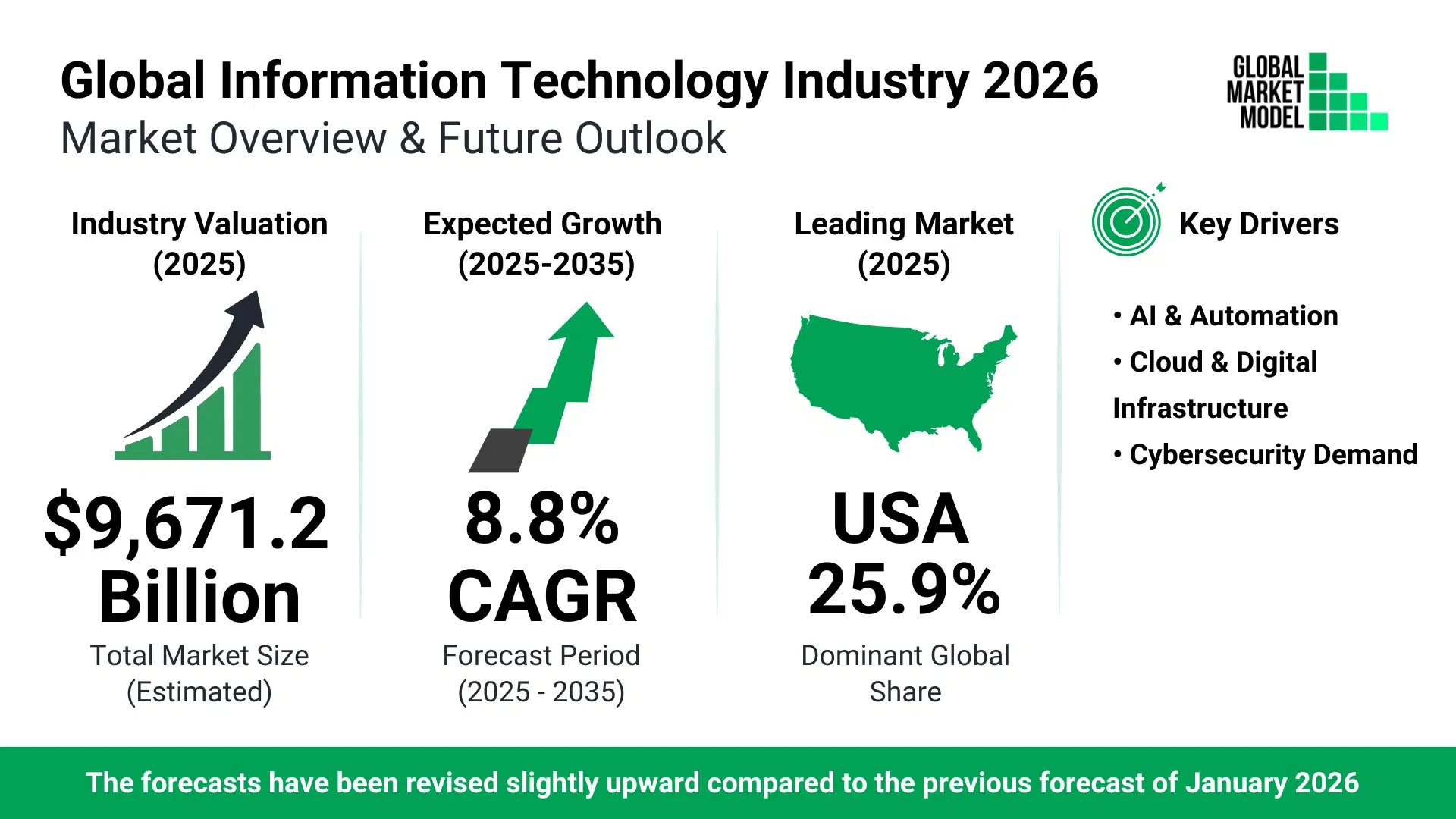
According to the latest Global Market Model forecast, the global information technology (IT) market was valued at $9,671.2 billion in 2025 and is projected to grow at a compound annual growth rate (CAGR) of 8.8% from 2025 to 2035. Growth over the forecast period is expected to be supported by increasing adoption of Internet of Things (IoT) technologies, wider use of augmented reality (AR), virtual reality (VR), and blockchain applications, and continued rollout of 5G infrastructure. Expanding e-commerce, smart city initiatives, enterprise automation, and growing investment in cybersecurity are also expected to contribute to market growth.
What's Driving Growth in the Global Information Technology Market?
The IT industry continues to expand as organizations accelerate digital transformation and increase investments in technologies that improve productivity, connectivity, and operational efficiency.
Key growth drivers include:
- Increasing adoption of Internet of Things (IoT) technologies
- Growing use of AR, VR, and blockchain applications
- Expansion of 5G infrastructure
- Rising e-commerce activity
- Smart city development initiatives
- Growing emphasis on cybersecurity and enterprise automation
These trends continue to increase demand for software, cloud services, IT consulting, networking solutions, and digital infrastructure across industries.
IT Services Remain the Largest Segment
The IT services segment accounted for 47.5% of the global information technology market in 2025, making it the largest segment within the industry.
Overall, the market represented 8.2% of global GDP in 2025.
Demand continues to be supported by:
- High levels of internet connectivity
- Broad digital transformation across industries
- Strong enterprise spending on cloud computing, software, and IT services
- Favorable government policies supporting digital infrastructure
- Widespread adoption of digital platforms across public and private sectors
These factors continue to reinforce long-term demand for information technology solutions worldwide.
The United States Remains the Largest Information Technology Market
The United States accounted for 25.9% of the global information technology market in 2025, supported by strong enterprise technology investment, advanced digital infrastructure, and continued innovation across software, cloud computing, semiconductors, and IT services.
Many other countries are also increasing investments in digital infrastructure and technology modernization to improve productivity and economic competitiveness.
AI Investment and Cloud Adoption Continue to Support Market Growth
The July 2026 Global Market Model forecast has been revised slightly upward compared with the previous forecast, reflecting developments over the past six months.
Enterprise IT spending has remained cautious, with some organizations delaying hardware upgrades and infrastructure expansion while maximizing returns from existing digital investments. Rising prices for RAM, high-bandwidth memory, GPUs, servers, storage components, and other data centre hardware have increased infrastructure costs while also contributing to higher market values across memory, semiconductor, server, and data centre equipment markets.
Demand for artificial intelligence continues to grow, with increased investment in generative AI, automation, and advanced analytics. At the same time, regulatory challenges, including export restrictions and evolving data compliance requirements, together with geopolitical tensions such as the Iran-Israel conflict, have added complexity by affecting semiconductor supply chains, energy costs, and global technology trade flows.
Despite these short-term challenges, long-term market growth remains supported by sustained investment in cloud computing, cybersecurity, enterprise automation, and AI-driven technologies.
The Global Market Model provides comprehensive information technology market intelligence, including:
- Number of internet users
- Number of households with computers
- Number of smartphone users
- Number of households with broadband access
- Number of enterprises
- Number of employees
All historical market data for the information technology market has also been updated during this forecast cycle to reflect revisions from primary data sources and additional market information.
Want deeper insights into the global information technology market, country-level forecasts, and industry benchmarks?Request a Demo
The Global Market Model is the world's largest database of market forecasts. Forecasts for over 30,000 markets are updated semi-annually on the basis of economic, geo-political and sector-specific factors. The current forecast was made in July 2026, revising the previous forecasts made in January 2026.
The world's most comprehensive database
- For further information and inquiries:
Global Market Model - Europe: +44 788 2955 267
- Asia: +44 788 2955 267 & +91 88972 63534
- America: +1 310 496 7795
Machinery Market Valued at $3,916.3 Billion in 2025, Projected to Grow at a 6.4% CAGR Through 2035
Global Machinery Market Forecast Indicates Steady Growth Through 2035
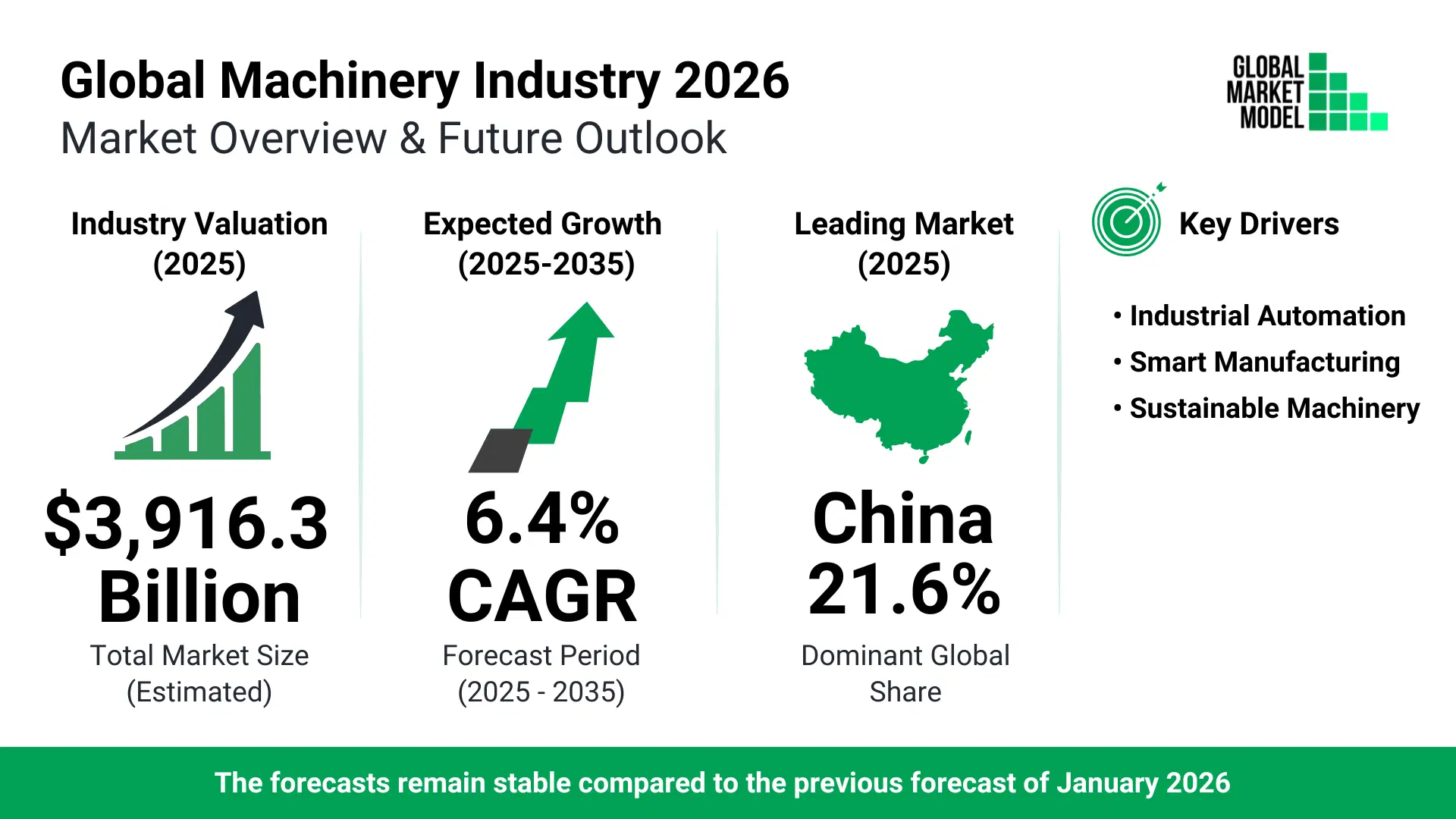
According to the latest Global Market Model forecast, the global machinery market was valued at $3,916.3 billion in 2025 and is projected to grow at a compound annual growth rate (CAGR) of 6.4% from 2025 to 2035. Growth is expected to be driven by technological advances, including the digitization of machines, industrial automation, and Internet of Things (IoT) integration. Increasing investment in smart manufacturing, energy-efficient machinery, renewable energy infrastructure, and robotics is also expected to support market expansion over the forecast period.
What's Driving Growth in the Global Machinery Market?
Manufacturers across industries are increasingly investing in modern equipment to improve productivity, reduce operating costs, and meet sustainability goals.
Key growth drivers include:
- Digitization of industrial machinery
- Growing adoption of automation and IoT-enabled equipment
- Rising investment in smart manufacturing technologies
- Increasing demand for energy-efficient and sustainable machinery
- Rapid industrialization across emerging economies
- Expanding use of robotics and advanced material-handling equipment
These trends continue to accelerate demand for modern machinery across manufacturing, construction, agriculture, mining, and logistics sectors.
Agriculture, Construction, and Mining Machinery Remain the Largest Segment
The agriculture, construction, and mining machinery segment accounted for 20.8% of the global machinery market in 2025, making it the largest segment within the industry.
Overall, the machinery market represented 3.3% of global GDP in 2025.
Market demand continues to be supported by:
- Large end-use industries across developed and developing economies
- Highly developed industrial manufacturing bases
- Continuous technological advancements in industrial equipment
- Favorable government policies supporting manufacturing and industrial development
These factors continue to strengthen long-term investment in industrial machinery worldwide.
China Remains the Largest Machinery Market
China accounted for 21.6% of the global machinery market in 2025, supported by its large manufacturing sector, extensive industrial base, and continued investment in automation and infrastructure development.
Other emerging economies are also increasing investments in industrial capacity, construction projects, and manufacturing modernization, creating additional opportunities for machinery manufacturers.
Automation and Energy Transition Continue to Support a Stable Market Outlook
The July 2026 Global Market Model forecast remains largely stable compared with the previous forecast.
Over the past six months, machinery demand has been influenced by input cost volatility, cautious capital expenditure, and a gradual recovery in construction and industrial activity. While easing interest rates in some major economies have improved financing conditions, many businesses, particularly small and medium-sized enterprises, continue to extend equipment replacement cycles and take a more selective approach to new machinery purchases.
Trade policy uncertainty, tariffs, and fluctuating prices of imported components, including engines, hydraulics, and precision parts, have also contributed to cautious procurement decisions. Additionally, geopolitical tensions such as the Iran-Israel conflict have affected energy prices and global supply chains, increasing manufacturing and operating costs.
Despite these challenges, continued investment in industrial automation, renewable energy infrastructure, productivity-enhancing equipment, and sustainable manufacturing technologies is expected to support stable market performance in the near term and positive long-term growth.
The Global Market Model provides comprehensive machinery market intelligence, including:
- Number of enterprises
- Number of employees
Want deeper insights into the global machinery market, country-level forecasts, and industry benchmarks?Request a Demo
The Global Market Model is the world's largest database of market forecasts. Forecasts for over 30,000 markets are updated semi-annually on the basis of economic, geo-political and sector-specific factors. The current forecast was made in July 2026, revising the previous forecasts made in January 2026.
The world's most comprehensive database
- For further information and inquiries:
Global Market Model - Europe: +44 788 2955 267
- Asia: +44 788 2955 267 & +91 88972 63534
- America: +1 310 496 7795
Media Market Growth Driven by Digital Content Consumption, Social Media, and Immersive Technologies
Global Media Market Forecast Signals Strong Growth Through 2035
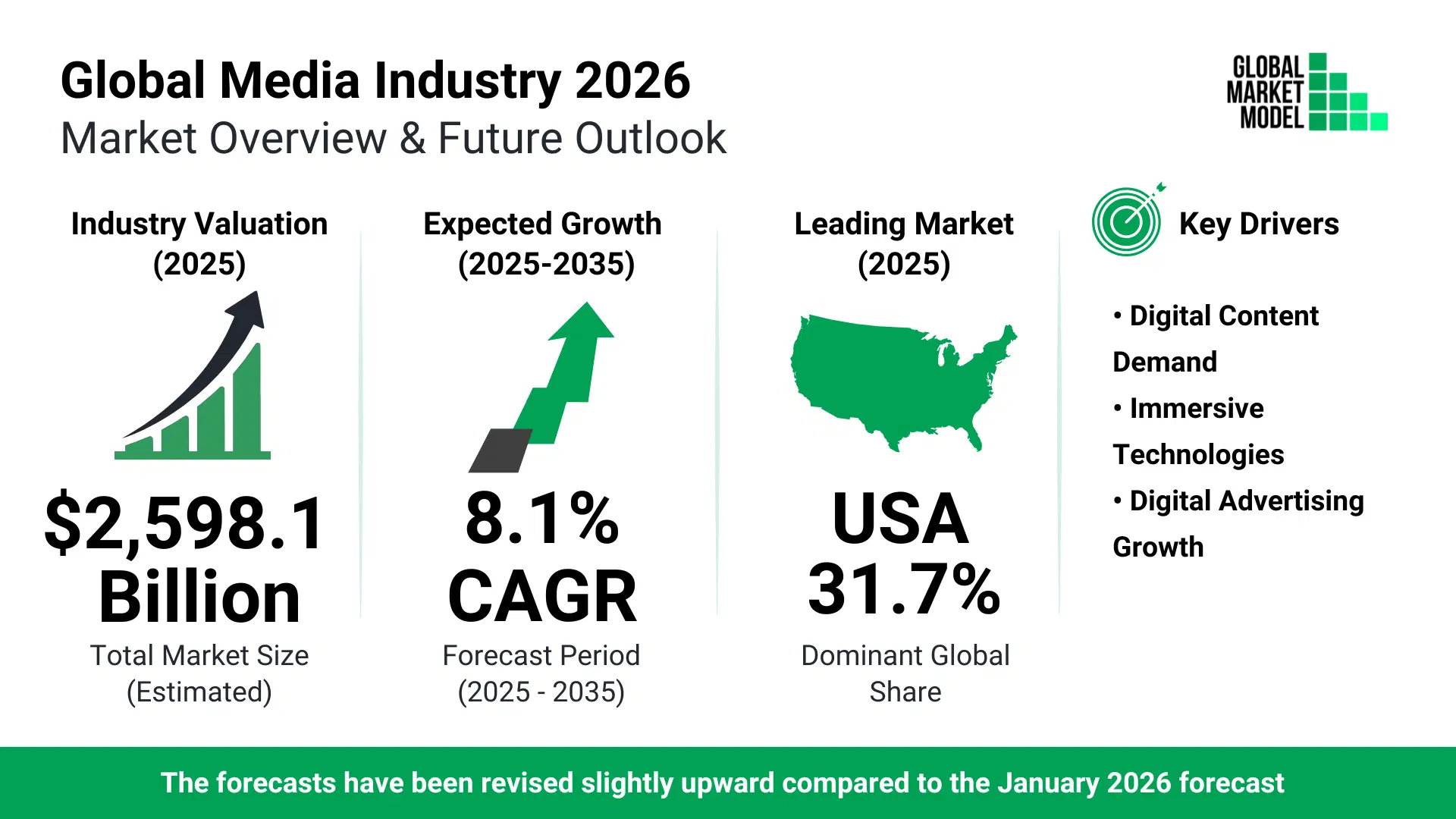
According to the latest Global Market Model forecast, the global media market was valued at $2,598.1 billion in 2025 and is projected to grow at a compound annual growth rate (CAGR) of 8.1% from 2025 to 2035. Growth is expected to be led by the rapid expansion of the web content, search portals, and social media market, supported by increasing internet connectivity, rising consumer spending on digital entertainment, and continued innovation in immersive technologies.
The growing adoption of augmented reality (AR), virtual reality (VR), and AI-powered content creation is transforming how consumers discover, engage with, and consume digital media.
What's Driving Growth in the Global Media Market?
The media industry continues to evolve as audiences spend more time on digital platforms and businesses shift advertising budgets toward online channels.
Key growth drivers include:
- Growing use of internet-enabled devices
- Faster network speeds and improved digital connectivity
- Rising adoption of augmented reality (AR) and virtual reality (VR)
- Increasing consumer spending on digital content and streaming services
- Higher advertising revenues from digital platforms
- Continued expansion of web content, search portals, and social media platforms
These trends are accelerating the shift toward digital-first media consumption while creating new monetization opportunities for publishers, streaming platforms, and content creators.
Web Content, Search Portals, and Social Media Lead the Market
The web content, search portals, and social media segment accounted for 29.4% of the global media market in 2025, making it the largest segment within the industry.
Overall, the media market represented 2.2% of global GDP in 2025.
Demand continues to be supported by:
- A large global consumer base across developed and emerging economies
- High internet and smartphone penetration
- Growing social media usage
- Increasing spending on digital entertainment, including films and video content
These factors continue to strengthen demand across digital media platforms and online advertising ecosystems.
The United States Remains the Largest Media Market
The United States accounted for 31.7% of the global media market in 2025, supported by high digital advertising expenditure, strong streaming adoption, and a mature digital content ecosystem.
Other markets are also witnessing rapid growth as expanding internet access and smartphone adoption continue to increase digital media consumption worldwide.
Digital Monetization and Immersive Experiences Continue to Reshape the Industry
The July 2026 Global Market Model forecast has been revised slightly upward compared with the previous forecast, reflecting improving conditions across the global media industry.
Over the past six months, advertising spending has gradually recovered, particularly across retail, travel, FMCG, and consumer services, supporting revenue growth for digital media platforms. Streaming providers have continued expanding ad-supported and hybrid subscription models, helping attract and retain users amid growing price sensitivity.
At the same time, investments in immersive and interactive experiences, including AR-enabled content, live commerce, gaming integrations, and AI-driven content production tools, are increasing audience engagement and opening new revenue opportunities.
Although geopolitical tensions, including the Iran-Israel conflict, have introduced some uncertainty by affecting advertising budgets and consumer sentiment, continued demand for digital content, social media engagement, and performance-based advertising supports a stable near-term outlook and positive long-term market growth.
The Global Market Model provides comprehensive media market intelligence, including:
- Number of internet users
- Number of households with computers
- Number of smartphone users
- Number of households with broadband access
- Number of enterprises
- Number of employees
Want deeper insights into the global media market, country-level forecasts, and industry benchmarks?Request a Demo
The Global Market Model is the world's largest database of market forecasts. Forecasts for over 30,000 markets are updated semi-annually on the basis of economic, geo-political and sector-specific factors. The current forecast was made in July 2026, revising the previous forecasts made in January 2026.
The world's most comprehensive database
- For further information and inquiries:
Global Market Model - Europe: +44 788 2955 267
- Asia: +44 788 2955 267 & +91 88972 63534
- America: +1 310 496 7795
Medical Equipment Market Growth Driven by AI Diagnostics, Robotics, and Preventive Healthcare
Global Medical Equipment Market Forecast Signals Strong Growth Through 2035
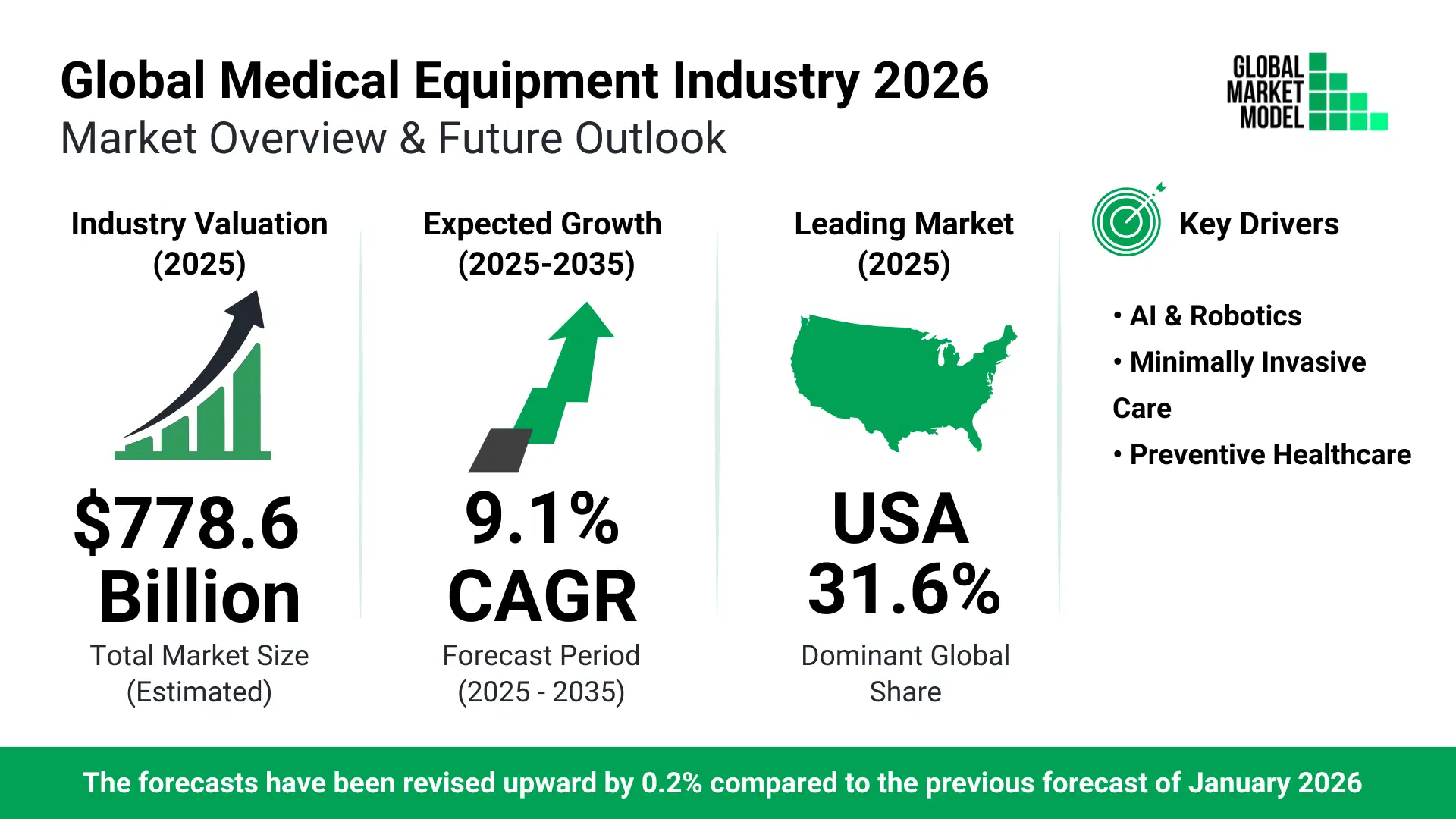
According to the latest Global Market Model forecast, the global medical equipment market was valued at $778.6 billion in 2025 and is projected to grow at a compound annual growth rate (CAGR) of 9.1% from 2025 to 2035. Growth is expected to be driven by rapid advances in artificial intelligence (AI), robotics, 3D printing, and machine learning technologies, alongside increasing healthcare expenditure and growing demand for preventive and minimally invasive healthcare solutions.
As healthcare providers continue to modernize clinical practices, demand for advanced diagnostic, monitoring, and treatment equipment is expected to remain strong throughout the forecast period.
What's Driving Growth in the Global Medical Equipment Market?
The medical equipment industry continues to benefit from technological innovation and increasing investment in healthcare infrastructure worldwide.
Key growth drivers include:
- Advances in AI-enabled diagnostics and machine learning
- Growing adoption of robotics in healthcare
- Increasing use of 3D printing technologies
- Rising healthcare expenditure across developed and emerging economies
- Higher demand for minimally invasive procedures
- Growing emphasis on preventive healthcare and early disease detection
These trends are accelerating the adoption of advanced medical technologies across hospitals, diagnostic laboratories, ambulatory care centres, and home healthcare settings.
In-Vitro Diagnostics Remain the Largest Market Segment
The in-vitro diagnostics segment accounted for 17.2% of the global medical equipment market in 2025, making it the largest segment within the industry.
Overall, the medical equipment market represented 0.7% of global GDP in 2025.
The market continues to be supported by:
- High prevalence of chronic and infectious diseases
- Strong adoption of advanced healthcare technologies
- Growing aging population worldwide
- Continued investment by hospitals in modern healthcare infrastructure
These factors continue to strengthen demand for diagnostic, imaging, monitoring, and therapeutic equipment across healthcare systems.
The United States Remains the Largest Medical Equipment Market
The United States accounted for 31.6% of the global medical equipment market in 2025, supported by high healthcare expenditure, rapid technology adoption, and significant investment in medical innovation.
Healthcare providers across other major markets are also increasing investments in advanced diagnostic technologies, connected medical devices, and digital healthcare infrastructure to improve patient outcomes.
AI-Powered Diagnostics and Remote Care Support an Improved Market Outlook
The July 2026 Global Market Model forecast has been revised upward by 0.2% compared with the previous forecast.
Over the past six months, consistent demand for diagnostic and patient monitoring equipment has been supported by the growing prevalence of chronic diseases and aging populations. The shift toward home-based and remote healthcare has further increased demand for portable and connected medical devices, while advances in AI-enabled diagnostics and minimally invasive technologies have encouraged continued investment by healthcare providers.
Supply conditions have also improved, with better availability of components helping ease earlier manufacturing disruptions. Although geopolitical tensions, including the Iran-Israel conflict, have created cost pressures through fluctuations in energy prices and logistics, they have also reinforced the importance of resilient healthcare systems and continued investment in medical technologies.
The Global Market Model provides comprehensive medical equipment market intelligence, including:
- Asthma prevalence rate
- Cancer prevalence rate
- Cerebrovascular prevalence rate
- Dermatitis prevalence rate
- Diabetes prevalence rate
- Glaucoma prevalence rate
- Healthcare - number of employees
- Healthcare - number of enterprises
- Healthcare expenditure
- Hearing loss prevalence rate
- HIV prevalence rate
- Hospital beds
- Hypertension prevalence rate
Want deeper insights into the global medical equipment market, country-level forecasts, and industry benchmarks?Request a Demo
The Global Market Model is the world's largest database of market forecasts. Forecasts for over 30,000 markets are updated semi-annually on the basis of economic, geo-political and sector-specific factors. The current forecast was made in July 2026, revising the previous forecasts made in January 2026.
The world's most comprehensive database
- For further information and inquiries:
Global Market Model - Europe: +44 788 2955 267
- Asia: +44 788 2955 267 & +91 88972 63534
- America: +1 310 496 7795
Metal and Mineral Market Valued at $8,119.1 Billion in 2025, Projected to Grow at a 4.2% CAGR Through 2035
Global Metal and Mineral Market Forecast Shows Steady Growth Through 2035
According to the latest Global Market Model forecast, the global metal and mineral market was valued at $8,119.1 billion in 2025 and is projected to grow at a compound annual growth rate (CAGR) of 4.2% from 2025 to 2035. Growth over the forecast period is expected to be supported by increasing demand for lightweight metals, expanding industrial activity, and the accelerating transition toward renewable energy and electric vehicles. Rising consumption of copper and other critical minerals is also expected to strengthen long-term market demand.
What's Driving Growth in the Global Metal and Mineral Market?
The metal and mineral industry continues to evolve as manufacturers and governments invest in infrastructure, electrification, and sustainable technologies that require large volumes of industrial metals and critical minerals.
Key growth drivers include:
- Increasing use of aluminum as a lightweight and cost-effective substitute
- Rising demand for copper across multiple end-user industries
- Growing adoption of electric vehicles
- Expansion of renewable energy infrastructure
- Increasing demand for lithium, cobalt, nickel, and rare earth elements
- Continued industrialization across developed and emerging economies
These trends continue to increase demand for metals and minerals used in manufacturing, construction, transportation, electronics, and clean energy applications.
Metal Products Continue to Account for the Largest Share of the Market
The metal market accounted for 52.4% of the global metal and mineral market in 2025, making it the largest segment within the industry.
Overall, the market represented 6.9% of global GDP in 2025.
Demand continues to be supported by:
- Large populations across developed and developing countries
- Highly developed industrial economies
- Strong demand for fabricated metal products such as screws, nuts, bolts, springs, wires, boilers, and valves
- Growing consumption from end-user industries including precision machinery, motor vehicles, electrical equipment, construction, and aerospace
These industries continue to generate sustained demand for a wide range of metal products and industrial materials.
China Remains the Largest Metal and Mineral Market
China accounted for 26.7% of the global metal and mineral market in 2025, supported by its large manufacturing sector, extensive construction activity, and continued investment in industrial and infrastructure development.
The country's growing focus on renewable energy, electric vehicles, and advanced manufacturing also continues to drive demand for both traditional industrial metals and critical minerals.
Infrastructure Investment and Energy Transition Continue to Support Market Growth
The July 2026 Global Market Model forecast has been revised slightly upward by 0.1% compared with the previous forecast.
Over the past six months, market growth has been supported by steady demand from key end-use industries including construction, automotive, and renewable energy, particularly for steel, copper, and aluminum. Although manufacturers have continued to face input cost volatility, fluctuating energy prices, and trade policy uncertainty, these challenges have been partially offset by gradual improvements in supply chains and stable industrial activity.
Geopolitical tensions, including the Iran-Israel conflict, have contributed to fluctuations in energy and transportation costs, influencing production expenses and commodity pricing. Despite these short-term pressures, continued investments in infrastructure, electrification, and energy transition projects continue to support stable market conditions and reinforce positive long-term growth prospects.
The Global Market Model provides comprehensive metal and mineral market intelligence, including:
- Number of enterprises
- Number of employees
Want deeper insights into the global metal and mineral market, country-level forecasts, and industry benchmarks?Request a Demo
The Global Market Model is the world's largest database of market forecasts. Forecasts for over 30,000 markets are updated semi-annually on the basis of economic, geo-political and sector-specific factors. The current forecast was made in July 2026, revising the previous forecasts made in January 2026.
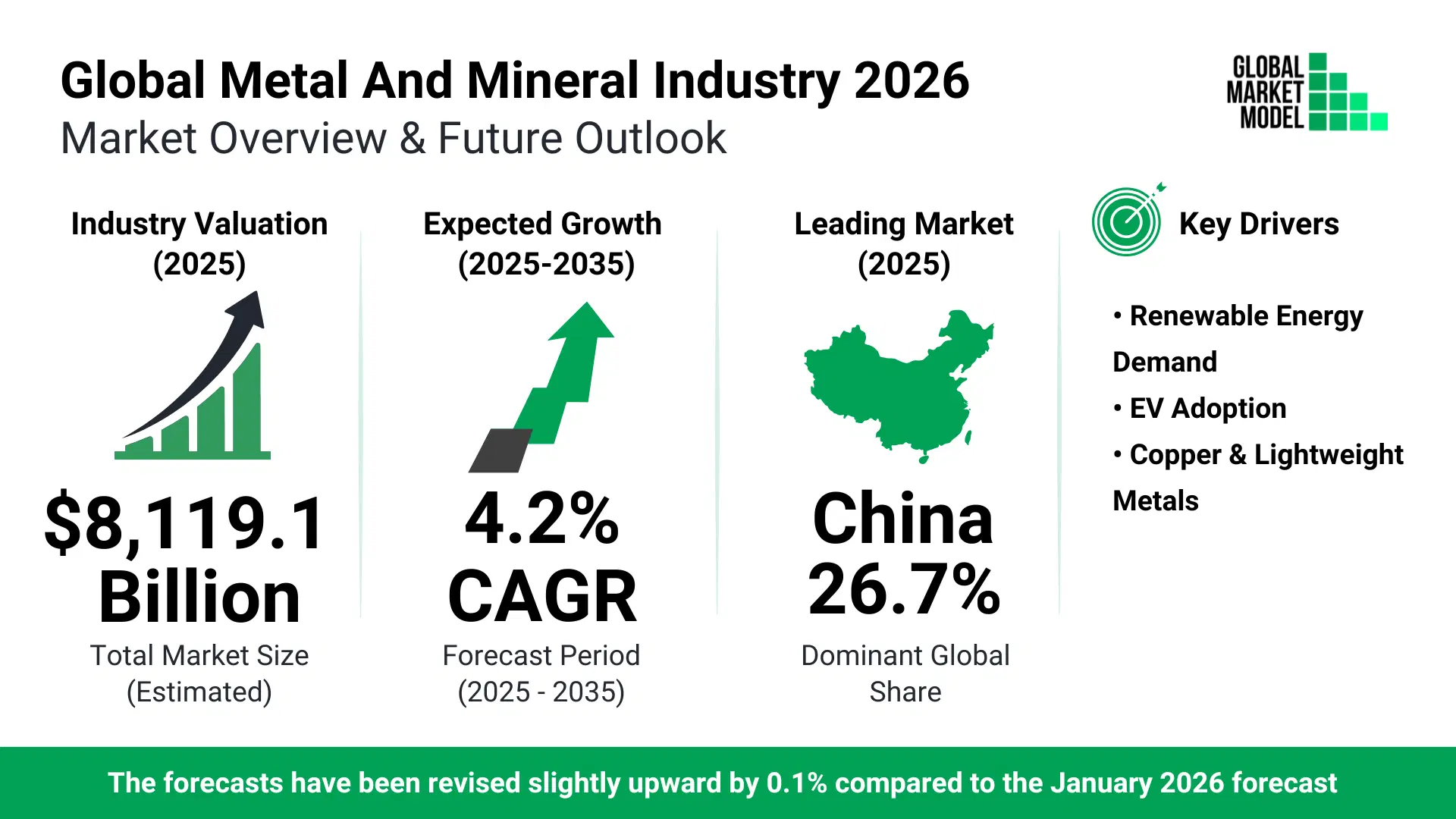
The world's most comprehensive database
- For further information and inquiries:
Global Market Model - Europe: +44 788 2955 267
- Asia: +44 788 2955 267 & +91 88972 63534
- America: +1 310 496 7795
Mining Market Valued at $2,065.0 Billion in 2025, Projected to Grow at a 6.0% CAGR Through 2035
Global Mining Market Forecast Indicates Steady Growth Through 2035
According to the latest Global Market Model forecast, the global mining market was valued at $2,065.0 billion in 2025 and is projected to grow at a compound annual growth rate (CAGR) of 6.0% from 2025 to 2035. Growth during the forecast period is expected to be driven by expanding infrastructure development, increasing adoption of autonomous mining equipment, and rising construction activity. Growing demand for minerals used in electric vehicle (EV) batteries, including lithium, nickel, graphite, and copper, is also expected to support long-term market expansion.
What's Driving Growth in the Global Mining Market?
The mining industry continues to play a critical role in supplying raw materials for infrastructure, manufacturing, and the global energy transition.
Key growth drivers include:
- Rising infrastructure development worldwide
- Growing implementation of autonomous mining equipment
- Expansion of construction projects across developed and emerging economies
- Increasing demand for electric vehicles
- Higher consumption of battery minerals such as lithium, nickel, graphite, and copper
- Continued investment in mining technologies and operational efficiency
These factors are strengthening demand for both traditional mining commodities and critical minerals essential for low-carbon technologies.
Coal, Lignite, and Anthracite Continue to Lead the Mining Market
The coal, lignite, and anthracite segment accounted for 47.2% of the global mining market in 2025, making it the largest segment within the industry.
Overall, the mining market represented 1.7% of global GDP in 2025.
Demand continues to be supported by:
- A large number of active mining operations globally
- High levels of investment in mining activities
- Strong demand from major end-use industries
- Large urban populations driving consumption of manufactured products derived from mined materials
These factors continue to support demand across both industrial minerals and metallic resources.
China Remains the Largest Mining Market
China accounted for 36.0% of the global mining market in 2025, supported by its large industrial base, extensive mining operations, and continued demand from manufacturing, construction, and infrastructure sectors.
The country's ongoing investments in strategic minerals and industrial development continue to reinforce its leading position in the global mining industry.
Critical Minerals and Automation Support an Improved Market Outlook
The July 2026 Global Market Model forecast has been revised upward by 0.23% compared with the previous forecast.
Over the past six months, the mining sector has demonstrated resilience, supported by sustained demand for critical minerals such as lithium, copper, and rare earth elements driven by global electrification and energy transition initiatives. Commodity prices have remained relatively stable compared with earlier periods of volatility, improving revenue visibility for mining companies and encouraging selective capacity expansion.
Government initiatives to strengthen domestic resource development and strategic mineral security have also improved investment sentiment across several key economies. Although regulatory complexity, environmental compliance requirements, and rising labour and equipment costs continue to present operational challenges, ongoing investment in automation, digital mining technologies, and productivity improvements has helped offset these pressures, supporting a stable near-term outlook and positive long-term market growth.
The Global Market Model provides comprehensive mining market intelligence, including:
- Number of enterprises
- Number of employees
Want deeper insights into the global mining market, country-level forecasts, and industry benchmarks?Request a Demo
The Global Market Model is the world's largest database of market forecasts. Forecasts for over 30,000 markets are updated semi-annually on the basis of economic, geo-political and sector-specific factors. The current forecast was made in July 2026, revising the previous forecasts made in January 2026.
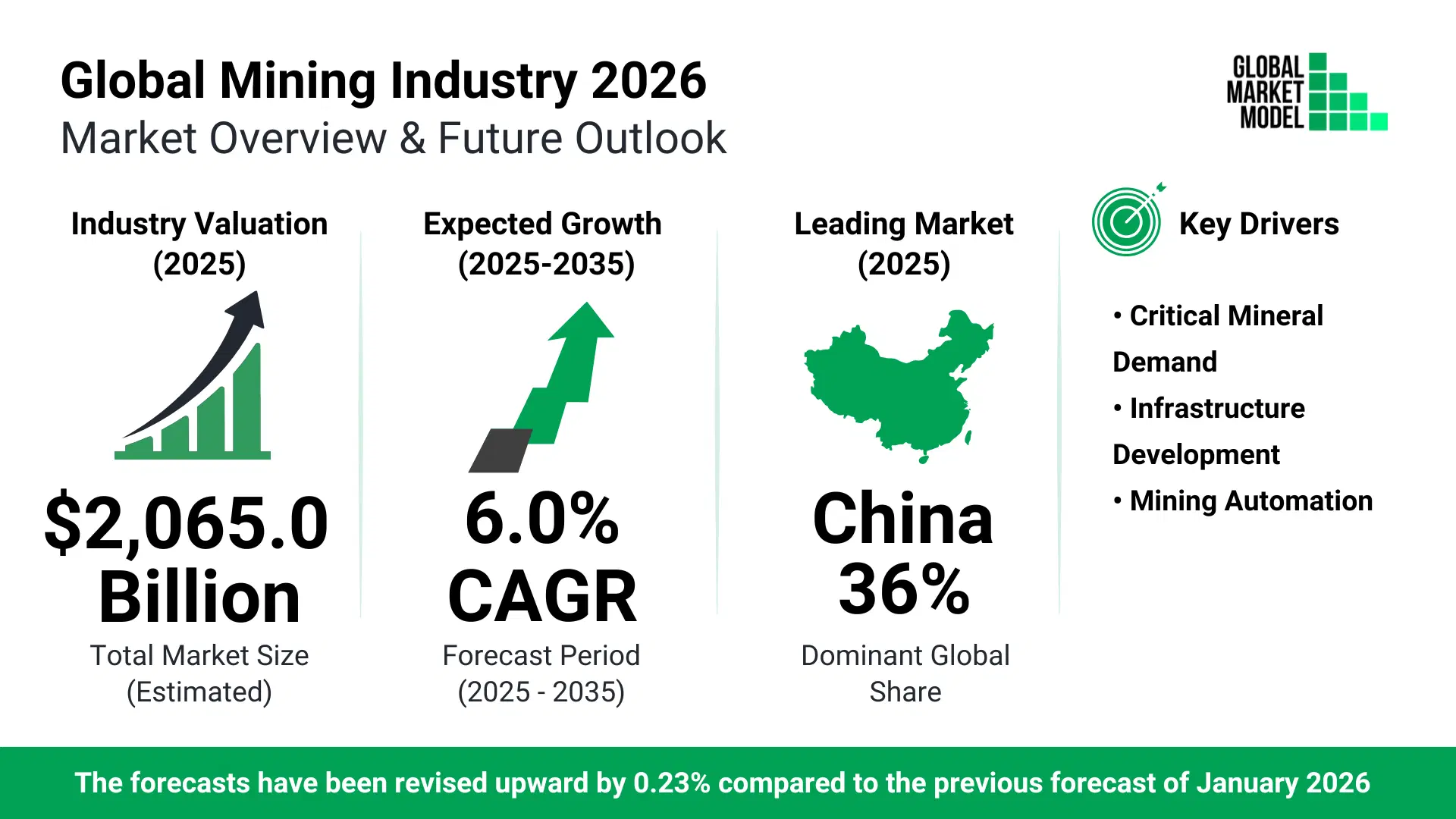
The world's most comprehensive database
- For further information and inquiries:
Global Market Model - Europe: +44 788 2955 267
- Asia: +44 788 2955 267 & +91 88972 63534
- America: +1 310 496 7795
Oil and Gas Market Growth Shaped by LNG Expansion, Enhanced Oil Recovery, and Exploration Technologies
Global Oil and Gas Market Forecast Indicates Steady Growth Through 2035
According to the latest Global Market Model forecast, the global oil and gas market was valued at $8,383.9 billion in 2025 and is projected to grow at a compound annual growth rate (CAGR) of 5.1% from 2025 to 2035. Growth over the forecast period is expected to be supported by technological innovation in exploration, drilling, and refining, alongside increasing adoption of enhanced oil recovery (EOR) techniques and continued exploration in untapped reserves. At the same time, the growing adoption of renewable energy is expected to gradually influence long-term demand for traditional fossil fuels.
What's Driving Growth in the Global Oil and Gas Market?
The oil and gas industry continues to evolve as producers invest in technologies that improve production efficiency while meeting global energy demand.
Key growth drivers include:
- Advances in oil and gas exploration, drilling, and refining technologies
- Growing adoption of enhanced oil recovery (EOR) techniques
- Increasing exploration activities in untapped regions
- Continued investment in natural gas infrastructure and LNG projects
- Rising energy demand from transportation, industrial, residential, and commercial sectors
- Energy security initiatives across major economies
These trends are helping producers improve recovery rates, expand production capacity, and strengthen long-term supply resilience.
Upstream Activities Continue to Lead the Oil and Gas Market
The oil and gas upstream activities segment accounted for 58.0% of the global oil and gas market in 2025, making it the largest segment within the industry.
Overall, the market represented 7.1% of global GDP in 2025.
Demand continues to be supported by:
- Strong consumption across transportation, industrial, residential, and commercial sectors
- Continued investment in upstream exploration and production
- Expanding natural gas infrastructure
- Ongoing global demand for reliable energy supplies
The market also remains highly sensitive to geopolitical developments, which continue to influence supply, pricing, and investment decisions.
The United States Remains the Largest Oil and Gas Market
The United States accounted for 16.3% of the global oil and gas market in 2025, supported by significant upstream production, technological innovation, and continued investment across exploration, production, refining, and liquefied natural gas (LNG) infrastructure.
The country continues to play a leading role in global energy production while investing in technologies that improve operational efficiency and resource recovery.
LNG Expansion and Energy Security Continue to Support Market Stability
The July 2026 Global Market Model forecast has been revised upward by 0.14% compared with the previous forecast.
Over the past six months, the market has been supported by steady global energy demand, particularly from transportation, industrial activity, and emerging economies, together with disciplined production strategies adopted by major oil-producing countries. Although crude oil prices have experienced moderate fluctuations, they have remained within a range that continues to support upstream investment.
Geopolitical tensions, including the Iran-Israel conflict, have contributed to periodic supply concerns, price volatility, and changing trade flows. At the same time, continued investment in LNG infrastructure, natural gas projects, and energy security initiatives has strengthened the industry's resilience. While energy transition policies, regulatory scrutiny, and capital discipline continue to influence investment decisions, the sector maintains a stable near-term outlook and positive long-term growth trajectory.
The Global Market Model provides comprehensive oil and gas market intelligence, including:
- Oil reserves
- Gas reserves
- Active rigs
- Oil refinery throughput
- Oil refinery capacity
- Number of enterprises
- Number of employees
Want deeper insights into the global oil and gas market, country-level forecasts, and industry benchmarks?Request a Demo
The Global Market Model is the world's largest database of market forecasts. Forecasts for over 30,000 markets are updated semi-annually on the basis of economic, geo-political and sector-specific factors. The current forecast was made in July 2026, revising the previous forecasts made in January 2026.
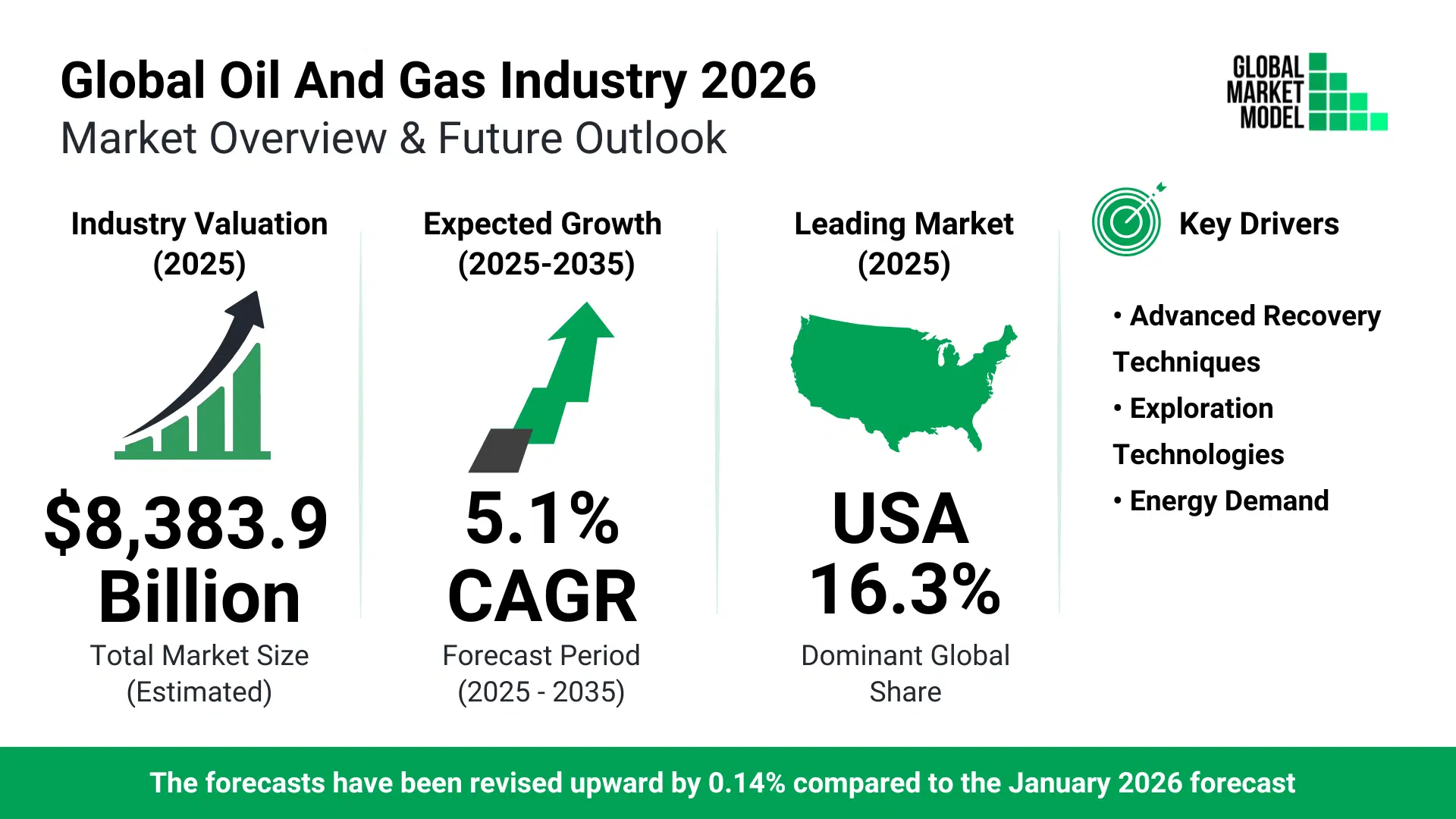
The world's most comprehensive database
- For further information and inquiries:
Global Market Model - Europe: +44 788 2955 267
- Asia: +44 788 2955 267 & +91 88972 63534
- America: +1 310 496 7795
Paper, Plastics, Rubber, Wood, and Textile Market Valued at $7,539.2 Billion in 2025, Projected to Grow at a 6.3% CAGR Through 2035
Global Paper, Plastics, Rubber, Wood, and Textile Market Forecast Shows Steady Growth Through 2035
According to the latest Global Market Model forecast, the global paper, plastics, rubber, wood, and textile market was valued at $7,539.2 billion in 2025 and is projected to grow at a compound annual growth rate (CAGR) of 6.3% from 2025 to 2035. The market continues to be supported by strong demand from packaging, retail, furniture, fashion, and construction industries. The continued expansion of e-commerce and increasing adoption of sustainable materials are expected to shape market growth over the forecast period.
What's Driving Growth in the Global Paper, Plastics, Rubber, Wood, and Textile Market?
Demand across the industry continues to be driven by expanding consumer markets, industrial activity, and changing sustainability requirements.
Key growth drivers include:
- Rising demand from packaging, retail, furniture, fashion, and construction industries
- Continued growth of e-commerce and food delivery services
- Increasing consumption of paperboard and flexible plastic packaging
- Growing preference for biodegradable and recyclable materials
- Rising investments in sustainable materials and recycling initiatives
- Expanding adoption of bio-based alternatives
These trends are encouraging manufacturers to innovate while improving material efficiency and sustainability across the value chain.
Plastics and Rubber Products Remain the Largest Market Segment
The plastics and rubber products segment accounted for 20.7% of the global paper, plastics, rubber, wood, and textile market in 2025, making it the largest segment within the industry.
Overall, the market represented 6.4% of global GDP in 2025.
Demand continues to be supported by:
- Rapid urbanization
- High consumer spending
- Large consumer populations across developed and developing economies
- Strong demand from multiple end-user industries
These factors continue to generate sustained demand across paper, plastics, rubber, wood, and textile products.
The United States Remains the Largest Market
The United States accounted for 21.5% of the global paper, plastics, rubber, wood, and textile market in 2025, supported by strong consumer demand, advanced manufacturing capabilities, and extensive consumption across packaging, construction, and consumer goods industries.
Continued investment in sustainable manufacturing and material innovation is expected to strengthen market competitiveness over the coming years.
Sustainability and E-Commerce Continue to Support Market Growth
The July 2026 Global Market Model forecast has been revised upward by 0.11% compared with the previous forecast.
Over the past six months, steady demand from packaging, construction, automotive, and consumer goods industries has supported market growth, particularly for plastics, rubber, and engineered wood products. The continued expansion of e-commerce and food delivery services has sustained demand for paper and packaging materials, while textile demand has remained stable with the gradual recovery of retail and apparel markets.
Although manufacturers continue to face input cost volatility for petrochemical derivatives, pulp, and natural rubber, along with supply chain pressures linked to energy price fluctuations and geopolitical tensions such as the Iran-Israel conflict, improving supply availability and operational adjustments have helped mitigate these challenges. At the same time, increasing investment in sustainable materials, recycling initiatives, and bio-based alternatives continues to support innovation and reinforce positive long-term market prospects.
The Global Market Model provides comprehensive market intelligence, including:
- Number of enterprises
- Number of employees
Want deeper insights into the global paper, plastics, rubber, wood, and textile market, country-level forecasts, and industry benchmarks?Request a Demo
The Global Market Model is the world's largest database of market forecasts. Forecasts for over 30,000 markets are updated semi-annually on the basis of economic, geo-political and sector-specific factors. The current forecast was made in July 2026, revising the previous forecasts made in January 2026.
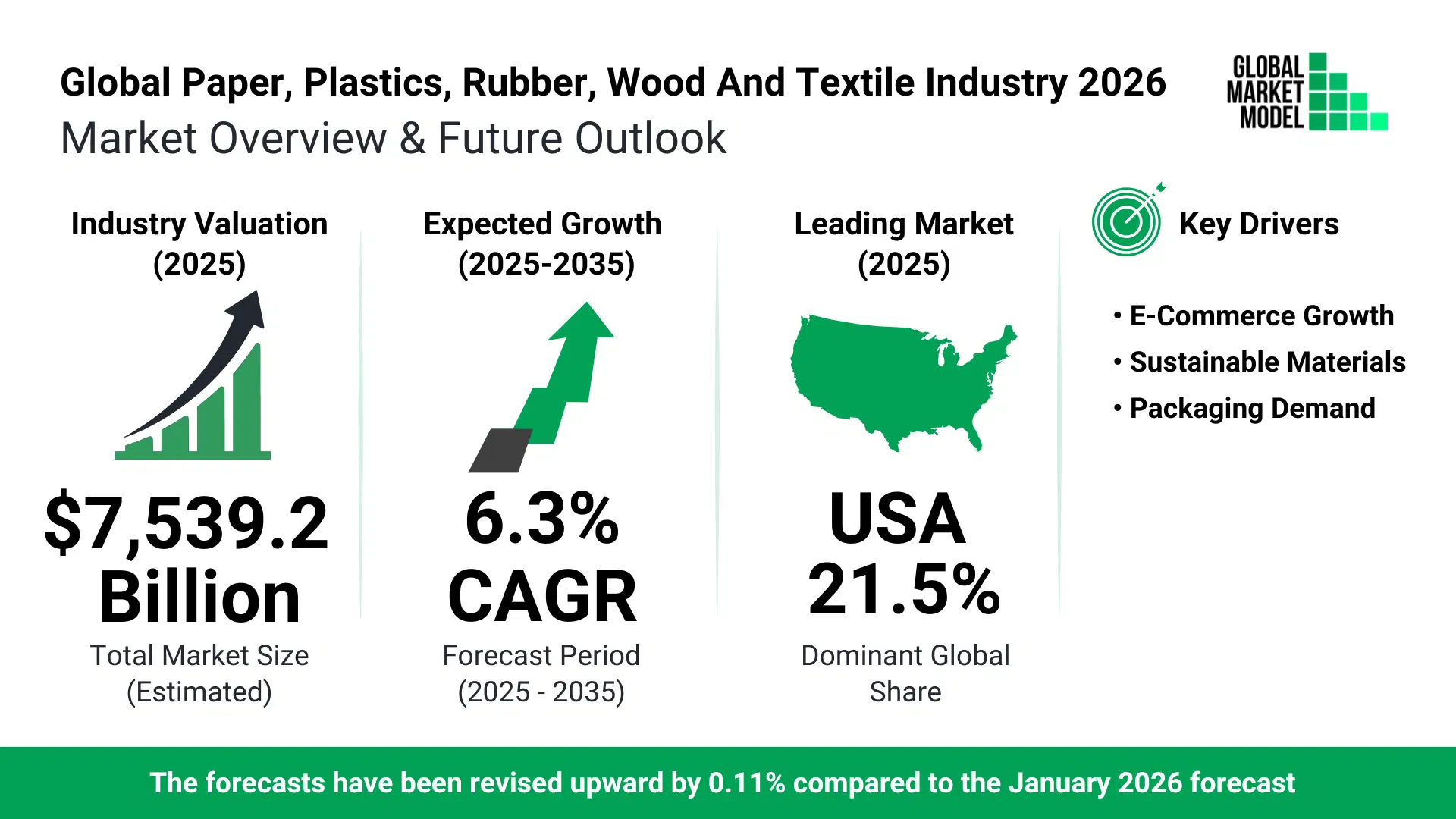
The world's most comprehensive database
- For further information and inquiries:
Global Market Model - Europe: +44 788 2955 267
- Asia: +44 788 2955 267 & +91 88972 63534
- America: +1 310 496 7795
Pharmaceuticals Market Valued at $1,867.1 Billion in 2025, Driven by Personalized Medicine, Biologics, and Advanced Drug Technologies
Global Pharmaceuticals Market Forecast Shows Steady Growth Through 2035
According to the latest Global Market Model forecast, the global pharmaceuticals market was valued at $1,867.1 billion in 2025 and is projected to grow at a compound annual growth rate (CAGR) of 6.4% from 2025 to 2035. Growth is expected to be driven by increasing approvals of new weight loss drugs, emerging drug delivery technologies, and continued investment in personalized medicine. Rising demand for biologics and biosimilars, together with advances in stem cell therapies and organ chip technologies, are also expected to support market expansion.
What's Driving Growth in the Global Pharmaceuticals Market?
The pharmaceutical industry continues to evolve as healthcare systems invest in innovative therapies that improve treatment outcomes and address growing healthcare needs.
Key growth drivers include:
- Increasing approvals of new weight loss drugs
- Emerging drug delivery technologies such as microneedle patches and microchip systems
- Growing adoption of stem cell and organ chip technologies
- Rising investment in personalized medicine
- Increasing demand for biologics and biosimilars
- Continued innovation in advanced therapeutic approaches
These developments are helping pharmaceutical companies expand treatment options while improving the effectiveness and accessibility of modern medicines.
Oncology Drugs Continue to Lead the Pharmaceuticals Market
The oncology drugs segment accounted for 16.4% of the global pharmaceuticals market in 2025, making it the largest segment within the industry.
Overall, the pharmaceuticals market represented 1.6% of global GDP in 2025, with per capita consumption reaching $232.37 per person per annum.
Demand continues to be supported by:
- Large consumer populations across developed and developing countries
- Rising prevalence of chronic diseases
- High healthcare expenditure
- Mature pharmaceutical markets in North America and Europe with well-established healthcare systems
These factors continue to support sustained demand for prescription medicines, specialty therapies, and preventive healthcare products.
The United States Remains the Largest Pharmaceuticals Market
The United States accounted for 44.6% of the global pharmaceuticals market in 2025, supported by significant research and development investment, advanced healthcare infrastructure, and strong demand for innovative medicines.
North America and Europe continue to lead pharmaceutical innovation, while emerging markets are contributing to industry growth through expanding healthcare access and increasing medicine consumption.
Innovation and R&D Continue to Support an Improved Market Outlook
The July 2026 Global Market Model forecast has been revised upward by 0.13% compared with the previous forecast.
Over the past six months, the market has benefited from steady demand for essential and specialty medicines, alongside continued expansion in emerging economies. Increased investment in research and development, particularly in biologics, personalized treatments, and advanced therapies, has continued to drive pharmaceutical innovation.
The industry continues to face pricing pressures, regulatory complexity, and supply chain constraints affecting active pharmaceutical ingredients (APIs). Geopolitical tensions, including the Iran-Israel conflict, have also contributed to logistics disruptions and cost variability in certain regions. Despite these challenges, sustained demand for chronic disease treatments, vaccines, preventive care, and the growing adoption of digital health solutions continue to support a stable near-term outlook and positive long-term market growth.
The Global Market Model provides comprehensive pharmaceuticals market intelligence, including:
- Asthma prevalence rate
- Cancer prevalence rate
- Cerebrovascular prevalence rate
- Dermatitis prevalence rate
- Diabetes prevalence rate
- Glaucoma prevalence rate
- Hypertension prevalence rate
- Public healthcare expenditure
- Rheumatoid arthritis prevalence rate
- Thalassemia prevalence rate
- Tuberculosis prevalence rate
- HIV prevalence rate
- Number of dentists
- Hospital beds
- Number of hospitals
Want deeper insights into the global pharmaceuticals market, country-level forecasts, and industry benchmarks?Request a Demo
The Global Market Model is the world's largest database of market forecasts. Forecasts for over 30,000 markets are updated semi-annually on the basis of economic, geo-political and sector-specific factors. The current forecast was made in July 2026, revising the previous forecasts made in January 2026.
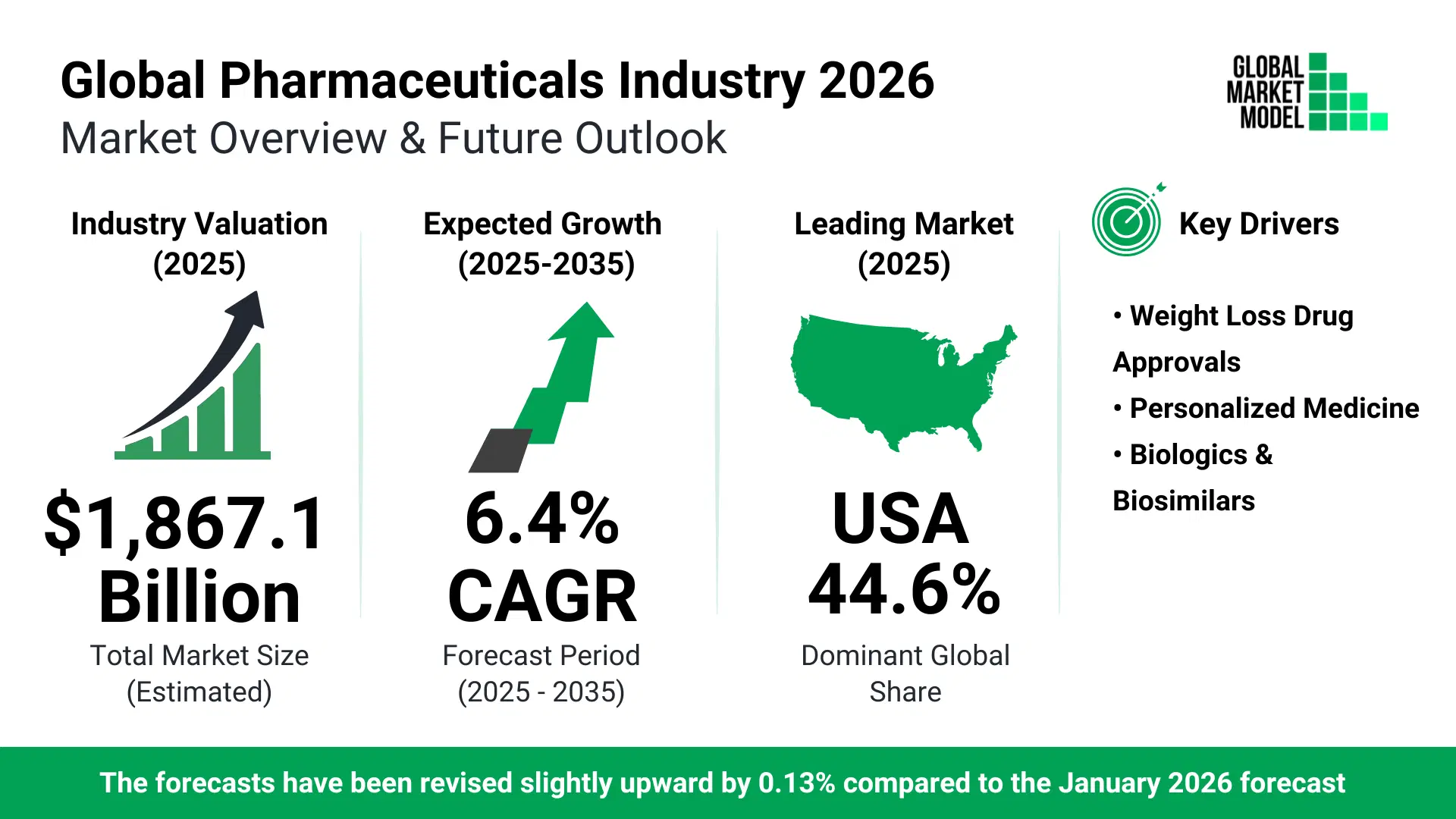
The world's most comprehensive database
- For further information and inquiries:
Global Market Model - Europe: +44 788 2955 267
- Asia: +44 788 2955 267 & +91 88972 63534
- America: +1 310 496 7795
Professional Services Market Projected to Grow at a 6.1% CAGR, Driven by Digital Transformation, ESG Compliance, and Smart City Investments
Global Professional Services Market Forecast Shows Steady Growth Through 2035
According to the latest Global Market Model forecast, the global professional services market was valued at $6,483.3 billion in 2025 and is projected to grow at a compound annual growth rate (CAGR) of 6.1% from 2025 to 2035. Growth is expected to be driven by increasing investments in smart cities, regulatory reforms, and transitions to new financial reporting standards. Rising demand for digital transformation consulting, expanding outsourcing of specialized business functions, and increasing focus on Environmental, Social, and Governance (ESG) compliance are also expected to support market expansion.
What's Driving Growth in the Global Professional Services Market?
Organizations across industries continue to rely on professional service providers to navigate regulatory changes, improve operational efficiency, and accelerate digital transformation.
Key growth drivers include:
- Increasing investments in smart city projects
- Regulatory reforms and financial reporting standards transitions
- Rising demand for digital transformation consulting
- Expanding outsourcing of specialized business functions
- Growing focus on ESG compliance and sustainability reporting
- Increasing adoption of technology-enabled advisory services
These trends continue to increase demand for consulting, legal, accounting, engineering, and business advisory services worldwide.
Design, Research, Promotional, and Consulting Services Remain the Largest Segment
The design, research, promotional, and consulting services segment accounted for 74.5% of the global professional services market in 2025, making it the largest segment within the industry.
Overall, the market represented 5.5% of global GDP in 2025.
Demand continues to be supported by:
- Significant investment in smart city development
- Strong demand for legal, accounting, engineering, and consulting services
- High service demand from industries including BFSI, construction, and healthcare
- Skilled workforces and government investment in developing economies such as India and China
These factors continue to reinforce the long-term demand for professional expertise across multiple industries.
The United States Remains the Largest Professional Services Market
The United States accounted for 38.4% of the global professional services market in 2025, supported by strong demand for legal, accounting, advertising, consulting, and other specialized business services.
Developing markets, including India and China, continue to expand their professional services sectors through growing investments, skilled talent availability, and increasing demand for outsourced business services.
Digital Consulting and Business Transformation Continue to Support Market Stability
The July 2026 Global Market Model forecast remains largely stable compared with the previous forecast.
Over the past six months, consistent demand for consulting, IT services, legal advisory, and outsourcing solutions has supported market growth as organizations continue prioritizing cost optimization, digital transformation, and operational efficiency. Demand for cloud adoption, cybersecurity, data analytics, and business process automation has remained particularly resilient.
Although geopolitical developments, including the Iran-Israel conflict, have influenced business sentiment in some regions, their overall impact on the sector has remained limited. Continued investment in strategic advisory, regulatory compliance, and technology-driven professional services is expected to support stable near-term performance and positive long-term market growth.
The Global Market Model provides comprehensive professional services market intelligence, including:
- Number of enterprises
- Number of employees
Want deeper insights into the global professional services market, country-level forecasts, and industry benchmarks?Request a Demo
The Global Market Model is the world's largest database of market forecasts. Forecasts for over 30,000 markets are updated semi-annually on the basis of economic, geo-political and sector-specific factors. The current forecast was made in July 2026, revising the previous forecasts made in January 2026.
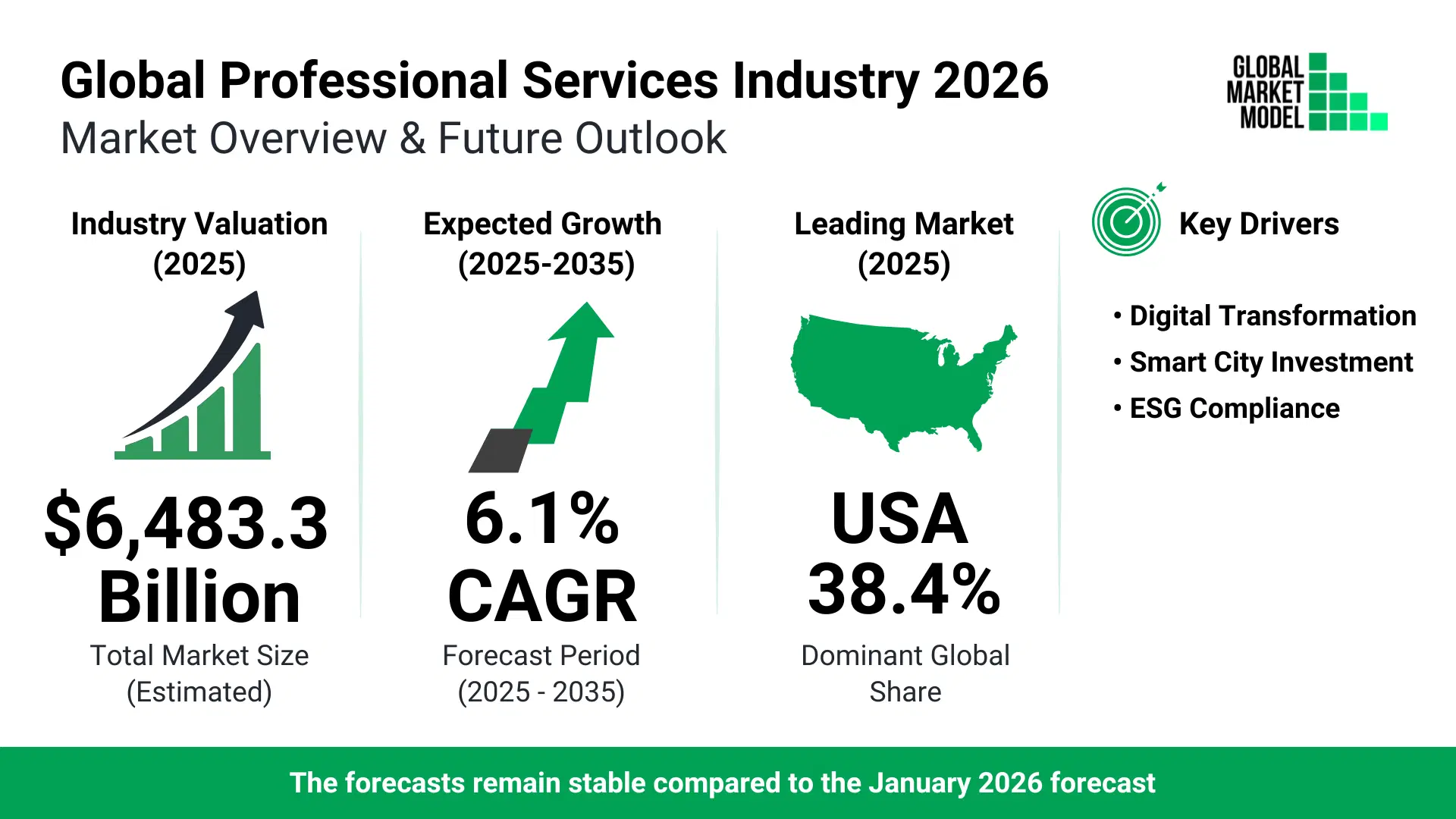
The world's most comprehensive database
- For further information and inquiries:
Global Market Model - Europe: +44 788 2955 267
- Asia: +44 788 2955 267 & +91 88972 63534
- America: +1 310 496 7795
Recreation Market Growth Driven by Experiential Travel, Wellness Trends, and Digital Entertainment
Global Recreation Market Forecast Shows Steady Growth Through 2035
According to the latest Global Market Model forecast, the global recreation market was valued at $1,746.4 billion in 2025 and is projected to grow at a compound annual growth rate (CAGR) of 5.4% from 2025 to 2035. Growth is expected to be supported by the legalization of gambling in several countries, increasing tourism and live entertainment activities, and rising consumer interest in health, wellness, and fitness. Continued investment in theme parks, leisure destinations, and outdoor recreation is also expected to contribute to market expansion.
What's Driving Growth in the Global Recreation Market?
The recreation industry continues to evolve as consumers prioritize experiences, leisure, and wellness alongside traditional entertainment options.
Key growth drivers include:
- Legalization of gambling across several countries
- Rising tourism and live performances
- Increasing focus on health, wellness, and fitness
- Growing investment in theme parks and leisure destinations
- Rising popularity of outdoor recreational activities
- Expanding digital entertainment and gaming experiences
These trends are encouraging businesses to diversify their offerings while creating new opportunities across tourism, entertainment, gaming, and leisure industries.
Amusement Activities Continue to Lead the Recreation Market
The amusements segment accounted for 38.9% of the global recreation market in 2025, making it the largest segment within the industry.
Overall, the recreation market represented 1.5% of global GDP in 2025, with per capita consumption reaching $217.35 per person per annum.
Demand continues to be supported by:
- Strong consumer spending on recreational activities in developed economies
- Rising disposable incomes across emerging markets
- Continued recovery and expansion of the global tourism industry
These factors continue to strengthen demand for leisure, entertainment, and destination-based experiences worldwide.
The United States Remains the Largest Recreation Market
The United States accounted for 28.3% of the global recreation market in 2025, supported by high consumer spending on entertainment, tourism, gaming, and leisure activities.
Growing tourism infrastructure and increasing investments in destination attractions across other regions are also contributing to market expansion.
Experiential Leisure and Digital Engagement Continue to Shape Market Growth
The July 2026 Global Market Model forecast has been revised upward compared with the previous forecast.
Over the past six months, market growth has been supported by increased consumer spending on leisure activities, travel, entertainment, and wellness experiences, alongside the continued recovery of tourism and outdoor recreation across multiple regions. Digital engagement through gaming and online entertainment has also contributed to sustained market demand.
Although inflationary pressures and geopolitical developments, including the Iran-Israel conflict, have influenced travel patterns and consumer sentiment in certain markets, the overall impact has remained moderate. Continued investment in experiential attractions, digital platforms, and leisure infrastructure is expected to support stable near-term performance and positive long-term growth for the recreation sector.
The Global Market Model provides comprehensive recreation market intelligence, including:
- Number of internet users
- Number of households with computers
- Number of smartphone users
- Number of households with broadband access
- Number of enterprises
- Number of employees
Want deeper insights into the global recreation market, country-level forecasts, and industry benchmarks?Request a Demo
The Global Market Model is the world's largest database of market forecasts. Forecasts for over 30,000 markets are updated semi-annually on the basis of economic, geo-political and sector-specific factors. The current forecast was made in July 2026, revising the previous forecasts made in January 2026.
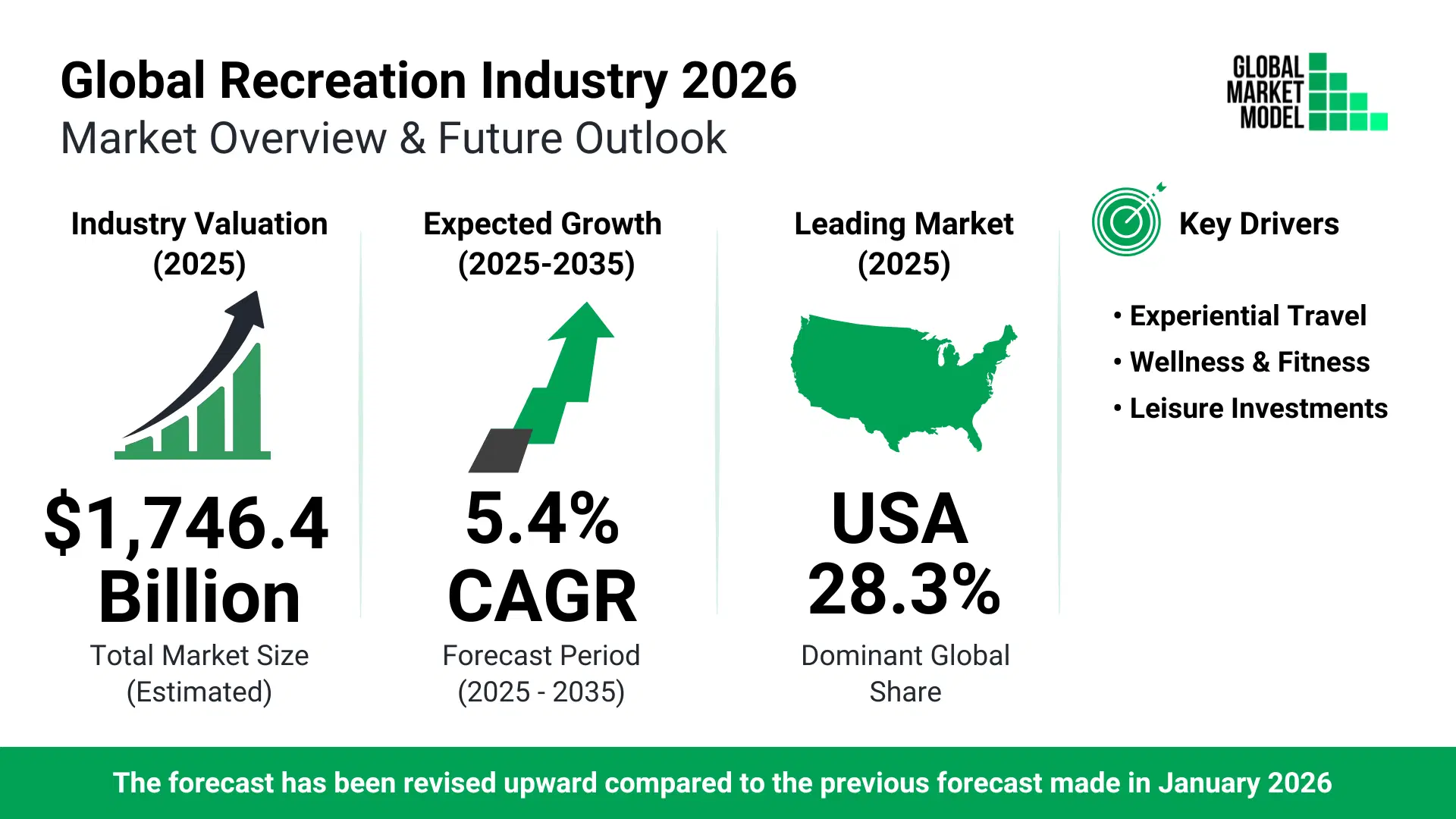
The world's most comprehensive database
- For further information and inquiries:
Global Market Model - Europe: +44 788 2955 267
- Asia: +44 788 2955 267 & +91 88972 63534
- America: +1 310 496 7795
Retail and Wholesale Market Valued at $90,158.3 Billion in 2025, Driven by E-Commerce Growth and Changing Consumer Preferences
Global Retail and Wholesale Market Forecast Shows Strong Growth Through 2035
According to the latest Global Market Model forecast, the global retail and wholesale market was valued at $90,158.3 billion in 2025 and is projected to grow at a compound annual growth rate (CAGR) of 6.8% from 2025 to 2035. Growth is expected to be supported by changing consumer lifestyles, expanding e-commerce platforms, and increasing demand across food, personal care, home improvement, and fashion categories. The growing emphasis on sustainable products and omnichannel retailing is also expected to strengthen market expansion during the forecast period.
What's Driving Growth in the Global Retail and Wholesale Market?
The retail and wholesale industry continues to evolve as consumers increasingly prioritize convenience, health, sustainability, and digital shopping experiences.
Key growth drivers include:
- Rising demand for nutrient-rich and healthy food products
- Growing popularity of vegan products
- Increasing demand for home décor products
- Expansion of cosmetics and personal care stores
- Growing influence of athleisure and lifestyle retail
- Continued growth of e-commerce platforms
- Rising consumer preference for sustainable and eco-friendly products
These trends are encouraging retailers and wholesalers to diversify product offerings while strengthening digital and omnichannel capabilities.
Wholesale Remains the Largest Segment of the Market
The wholesale segment accounted for 66.5% of the global retail and wholesale market in 2025, making it the largest segment within the industry.
Overall, the market represented 76.4% of global GDP in 2025, with per capita consumption reaching $11,220.53 per person per annum.
Demand continues to be supported by:
- Large consumer populations across developed and developing economies
- Expanding urban populations
- Rising disposable incomes
- Strong demand for food and beverage products
- Continued spending on healthcare and cosmetics
These factors continue to support growth across both wholesale distribution and retail sales channels.
The United States Remains the Largest Retail and Wholesale Market
The United States accounted for 26.2% of the global retail and wholesale market in 2025, supported by high consumer spending, a mature retail ecosystem, and continued investment in digital commerce and supply chain modernization.
Meanwhile, emerging markets continue to experience growth as rising incomes and increasing internet penetration accelerate both traditional and online retail activity.
Omnichannel Retail and Digital Commerce Continue to Strengthen the Market Outlook
The July 2026 Global Market Model forecast has been revised upward by 0.12% compared with the previous forecast.
Over the past six months, demand has improved gradually, supported by increased consumer spending on essential goods, continued e-commerce expansion, and better inventory management across retail and wholesale businesses. Seasonal demand, promotional campaigns, and the continued shift toward omnichannel retailing have also contributed to stable sales performance.
Although inflationary pressures, uneven consumer confidence, and geopolitical developments, including the Iran-Israel conflict, have created volatility in energy prices and supply chain costs, businesses have continued to adapt through digital transformation and supply chain optimization. These developments continue to support a stable near-term outlook and reinforce positive long-term growth prospects for the retail and wholesale market.
The Global Market Model provides comprehensive retail and wholesale market intelligence, including:
- Number of retail stores
- Number of enterprises
- Number of employees
Want deeper insights into the global retail and wholesale market, country-level forecasts, and industry benchmarks?Request a Demo
The Global Market Model is the world's largest database of market forecasts. Forecasts for over 30,000 markets are updated semi-annually on the basis of economic, geo-political and sector-specific factors. The current forecast was made in July 2026, revising the previous forecasts made in January 2026.
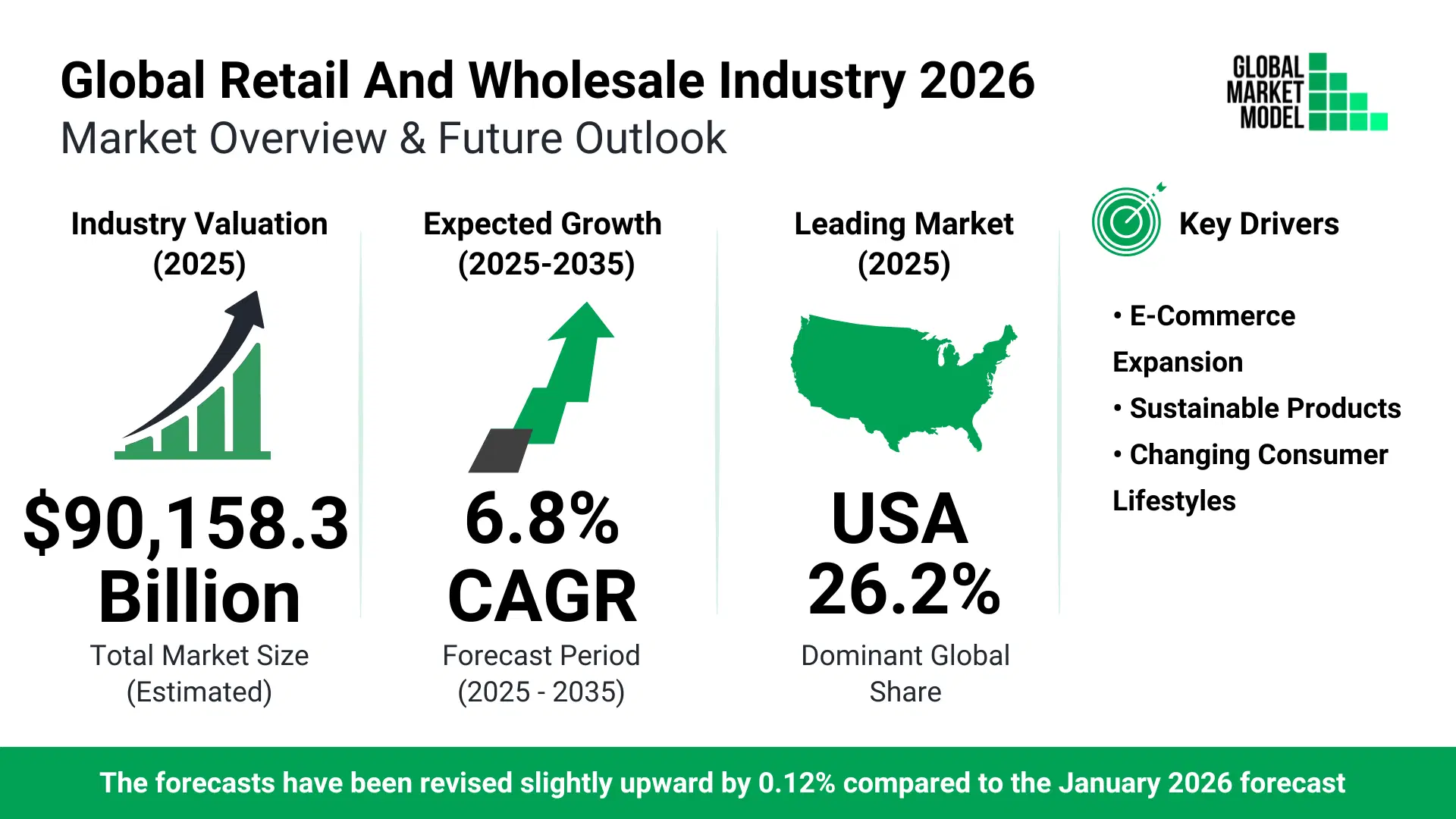
The world's most comprehensive database
- For further information and inquiries:
Global Market Model - Europe: +44 788 2955 267
- Asia: +44 788 2955 267 & +91 88972 63534
- America: +1 310 496 7795
Services Market Projected to Grow at an 8.3% CAGR, Driven by Outsourcing, Digital Transformation, and Urbanization
Global Services Market Forecast Shows Strong Growth Through 2035
According to the latest Global Market Model forecast, the global services market was valued at $17,179.6 billion in 2025 and is projected to grow at a compound annual growth rate (CAGR) of 8.3% from 2025 to 2035. Growth is expected to be driven by increasing business outsourcing, continued technological advancements, and expanding urbanization. Rising demand for real estate and leasing services, supported by the development of residential and commercial infrastructure, is also expected to contribute to market growth.
What's Driving Growth in the Global Services Market?
The services sector continues to expand as businesses increasingly prioritize operational efficiency, digital transformation, and specialized service providers.
Key growth drivers include:
- Growing outsourcing of non-core business operations
- Continued technological advancements across industries
- Expansion of urban centers and commercial infrastructure
- Rising demand for residential and commercial real estate services
- Increasing adoption of leasing services for machinery and vehicles
- Growing demand for business support and commercial services
These trends continue to strengthen demand for a broad range of professional, commercial, financial, real estate, and business support services.
Commercial Services Continue to Lead the Market
The commercial services segment accounted for 38.1% of the global services market in 2025, making it the largest segment within the industry.
Overall, the services market represented 14.6% of global GDP in 2025, with per capita consumption reaching $2,138.07 per person per annum.
Demand continues to be supported by:
- Strong demand for commercial support services
- Continued investment in residential and commercial construction
- Growing awareness and adoption of machinery and vehicle leasing
- Increasing reliance on outsourced business services across industries
These factors continue to support long-term expansion across the global services sector.
The United States Remains the Largest Services Market
The United States accounted for 27.9% of the global services market in 2025, supported by a mature business services ecosystem, high corporate spending, and strong demand across commercial, financial, real estate, and support service industries.
Many developing economies are also experiencing rapid growth as urbanization, digital adoption, and expanding business activity increase demand for a wide range of services.
Digital Services and Outsourcing Continue to Strengthen the Market Outlook
The July 2026 Global Market Model forecast has been revised upward by 0.13% compared with the previous forecast.
Over the past six months, demand has continued to improve across digital services, IT, financial services, and business support activities. Growth has also been supported by increasing adoption of cloud computing, data analytics, and outsourcing, together with rising demand for healthcare, logistics, and consumer-oriented services.
Although inflationary pressures and geopolitical developments, including the Iran-Israel conflict, have affected business sentiment and operating costs in certain regions, the services sector has remained resilient. Continued digital transformation and stable demand across both business and consumer services are expected to support a positive near-term outlook and sustained long-term market growth.
The Global Market Model provides comprehensive services market intelligence, including:
- Tons of waste collected
- Tons of waste recycled
- Number of enterprises
- Number of employees
Want deeper insights into the global services market, country-level forecasts, and industry benchmarks?Request a Demo
The Global Market Model is the world's largest database of market forecasts. Forecasts for over 30,000 markets are updated semi-annually on the basis of economic, geo-political and sector-specific factors. The current forecast was made in July 2026, revising the previous forecasts made in January 2026.
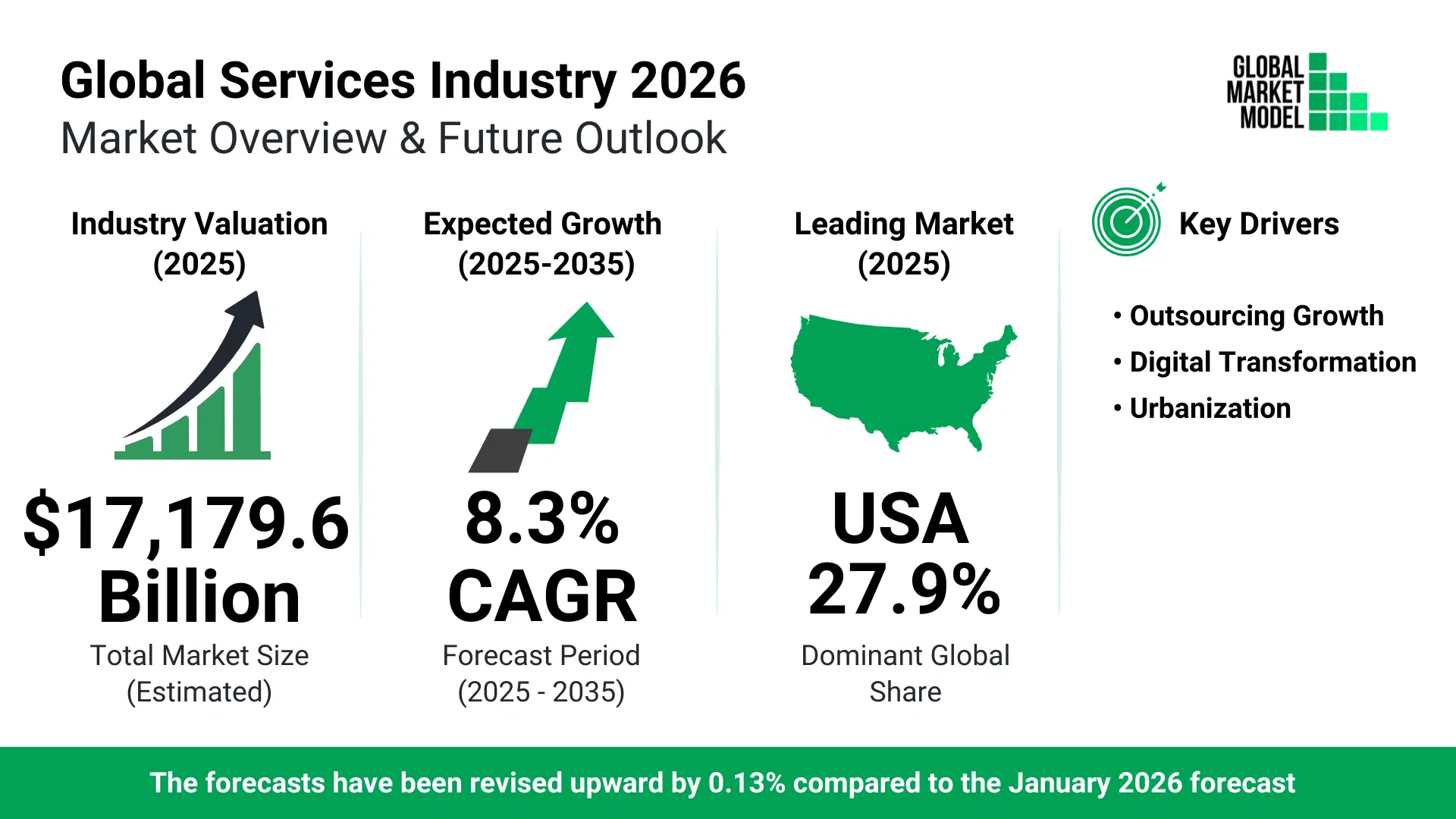
The world's most comprehensive database
- For further information and inquiries:
Global Market Model - Europe: +44 788 2955 267
- Asia: +44 788 2955 267 & +91 88972 63534
- America: +1 310 496 7795
Social Services Market Growth Driven by Digital Learning, Mental Health Awareness, and Smart Education Technologies
Global Social Services Market Forecast Shows Strong Growth Through 2035
According to the latest Global Market Model forecast, the global social services market was valued at $5,615.1 billion in 2025 and is projected to grow at a compound annual growth rate (CAGR) of 6.9% from 2025 to 2035. Growth is expected to be driven by the expansion of online learning, increasing use of crowdfunding, and the integration of smart technologies into education. The growing adoption of virtual and augmented reality in learning environments, together with rising awareness of mental health and wellness services, is also expected to support market expansion over the forecast period.
What's Driving Growth in the Global Social Services Market?
The social services sector continues to evolve as governments, educational institutions, and community organizations invest in digital technologies and initiatives that improve access to education, healthcare, and social support.
Key growth drivers include:
- Expansion of online learning platforms
- Growing use of crowdfunding to support social initiatives
- Integration of smart technologies into education
- Increasing adoption of virtual and augmented reality in learning
- Rising awareness of mental health and wellness services
- Continued investment in digital education and community support programs
These trends are improving access to essential social services while encouraging innovation across education, healthcare, and community welfare.
Educational Services Continue to Lead the Social Services Market
The educational services segment accounted for 67.5% of the global social services market in 2025, making it the largest segment within the industry.
Overall, the market represented 4.8% of global GDP in 2025.
Demand continues to be supported by:
- Government initiatives promoting digital learning
- High student enrolment across many countries
- Increasing internationalization of education
- Rapid growth of online teaching
- Government-university-industry partnerships
These factors continue to strengthen demand for educational and community-based services worldwide.
China Remains the Largest Social Services Market
China accounted for 15.5% of the global social services market in 2025, supported by continued investment in education, digital learning, healthcare, and public welfare programs.
The country's ongoing focus on expanding access to education and social support services continues to reinforce its leading position in the global market.
Government Investment and Community Support Continue to Strengthen Market Growth
The July 2026 Global Market Model forecast has been revised upward by 0.17% compared with the previous forecast.
Over the past six months, demand has strengthened due to increased government spending, greater focus on public health, education, and community support programs, and rising demand for social care services. Expansion of welfare initiatives, growing healthcare infrastructure investment, and increasing support for aging populations have further contributed to market growth.
Although fiscal constraints and geopolitical developments, including the Iran-Israel conflict, have influenced budget allocations and operating costs in some regions, the overall impact has remained moderate. Continued public sector investment and rising demand for education, healthcare, and community services are expected to support stable near-term performance and positive long-term market growth.
The Global Market Model provides comprehensive social services market intelligence, including:
- Number of students
- Number of enterprises
- Number of employees
Want deeper insights into the global social services market, country-level forecasts, and industry benchmarks?Request a Demo
The Global Market Model is the world's largest database of market forecasts. Forecasts for over 30,000 markets are updated semi-annually on the basis of economic, geo-political and sector-specific factors. The current forecast was made in July 2026, revising the previous forecasts made in January 2026.
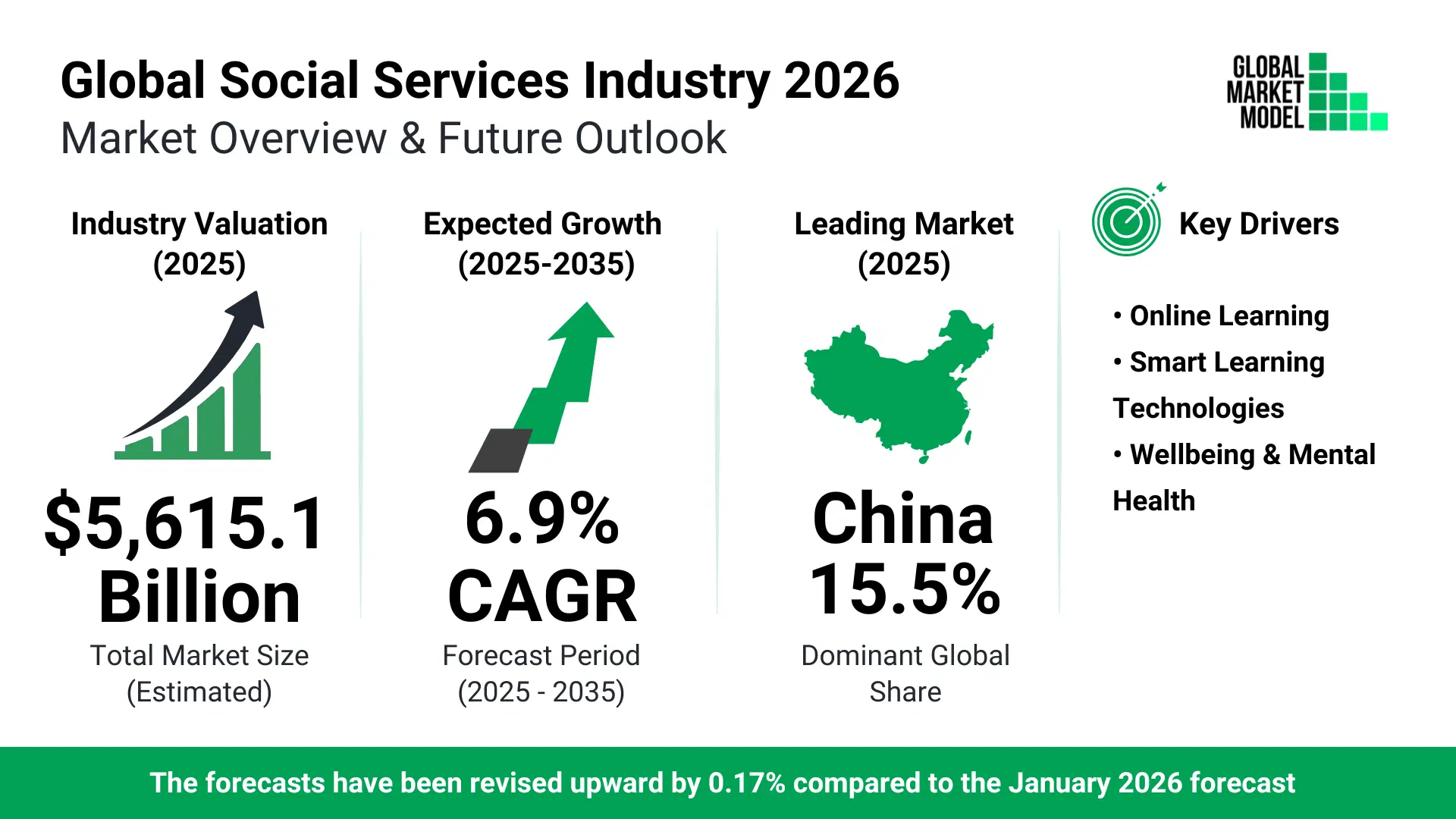
The world's most comprehensive database
- For further information and inquiries:
Global Market Model - Europe: +44 788 2955 267
- Asia: +44 788 2955 267 & +91 88972 63534
- America: +1 310 496 7795
Transport Market Growth Driven by Smart Mobility, Electric Vehicles, and E-Commerce Logistics
Global Transport Market Forecast Shows Strong Growth Through 2035
According to the latest Global Market Model forecast, the global transport market was valued at $6,803.2 billion in 2025 and is projected to grow at a compound annual growth rate (CAGR) of 7.0% from 2025 to 2035. Growth is expected to be driven by increasing demand for autonomous vehicles, electric vehicles (EVs), and smart mobility solutions. Expanding e-commerce, logistics networks, transportation infrastructure investments, and advancements in green energy technologies are also expected to support market growth throughout the forecast period.
What's Driving Growth in the Global Transport Market?
The transport industry continues to evolve as governments and manufacturers invest in cleaner, smarter, and more efficient transportation systems.
Key growth drivers include:
- Growing demand for autonomous vehicles
- Rising adoption of electric vehicles
- Increasing demand for smart mobility solutions
- Expansion of e-commerce and logistics networks
- Higher investment in transportation infrastructure
- Advancements in green energy technologies
These trends are accelerating innovation across passenger and commercial transport while strengthening global supply chain connectivity.
Motor Vehicle Parts Continue to Lead the Transport Market
The motor vehicle parts segment accounted for 42.7% of the global transport market in 2025, making it the largest segment within the industry.
Overall, the market represented 5.8% of global GDP in 2025.
Demand continues to be supported by:
- Large consumer populations across developed and developing economies
- Growing awareness and adoption of electric vehicles
- Continued demand for passenger transportation
- Rising need for commercial transport vehicles, including buses and vans
These factors continue to support sustained investment across the global transport equipment industry.
The United States Remains the Largest Transport Market
The United States accounted for 21.2% of the global transport market in 2025, supported by strong automotive production, transportation infrastructure, and continued investment in mobility technologies.
Many other countries are also increasing investment in transport modernization to improve logistics efficiency, connectivity, and sustainable mobility.
Logistics Digitalization and Infrastructure Investment Support an Improved Market Outlook
The July 2026 Global Market Model forecast has been revised upward by 0.10% compared with the previous forecast.
Over the past six months, the transport sector has benefited from increased movement of goods and the continued recovery in passenger travel across key regions. Growth has been supported by expanding e-commerce logistics, rising trade activity, and improvements in supply chain efficiency, alongside steady demand for road, rail, air, and maritime transportation services.
The industry continues to face challenges from fuel price volatility and rising operating costs, partly influenced by geopolitical tensions, including the Iran-Israel conflict, which has affected global shipping routes and energy prices. Despite these headwinds, ongoing investment in transportation infrastructure, logistics digitalization, and resilient global trade flows continues to support a stable near-term outlook and positive long-term growth.
The Global Market Model provides comprehensive transport market intelligence, including:
- Number of vehicles produced
- Number of vehicles sold
- Number of vehicles installed
- Number of enterprises
- Number of employees
Want deeper insights into the global transport market, country-level forecasts, and industry benchmarks?Request a Demo
The Global Market Model is the world's largest database of market forecasts. Forecasts for over 30,000 markets are updated semi-annually on the basis of economic, geo-political and sector-specific factors. The current forecast was made in July 2026, revising the previous forecasts made in January 2026.
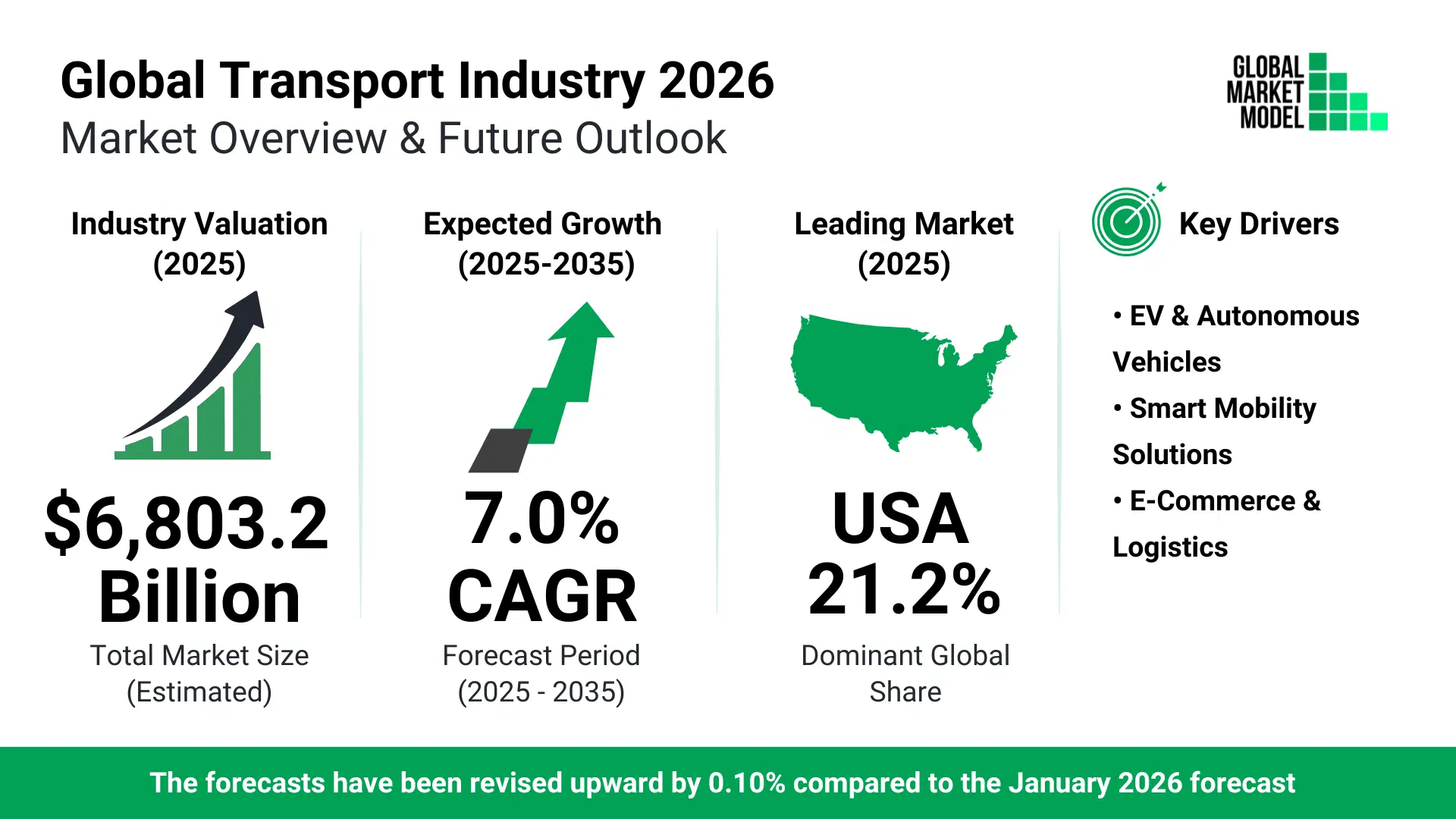
The world's most comprehensive database
- For further information and inquiries:
Global Market Model - Europe: +44 788 2955 267
- Asia: +44 788 2955 267 & +91 88972 63534
- America: +1 310 496 7795
Transport Services Market Growth Driven by Global Travel Recovery, E-Commerce Logistics, and Supply Chain Optimization
Global Transport Services Market Forecast Shows Strong Growth Through 2035
According to the latest Global Market Model forecast, the global transport services market was valued at $8,640.5 billion in 2025 and is projected to grow at a compound annual growth rate (CAGR) of 7.9% from 2025 to 2035. Growth is expected to be supported by increasing air transport demand as global tourism continues to recover, expanding warehousing and storage facilities, and growing adoption of sustainable pipeline transport for energy distribution. Continued investment in logistics technologies is also expected to strengthen the market over the forecast period.
What's Driving Growth in the Global Transport Services Market?
The transport services industry continues to expand as businesses and consumers demand faster, more efficient, and technology-enabled transportation and logistics solutions.
Key growth drivers include:
- Recovery in global tourism and increasing air passenger traffic
- Growing adoption of sustainable pipeline transport
- Expansion of warehousing and storage infrastructure
- Rapid growth of e-commerce and logistics services
- Increasing adoption of advanced technologies for logistics optimization
- Rising demand for integrated supply chain solutions
These trends continue to strengthen demand across passenger transport, freight services, warehousing, and logistics operations.
General Transport Services Continue to Lead the Market
The general transport segment accounted for 30.6% of the global transport services market in 2025, making it the largest segment within the industry.
Overall, the market represented 7.3% of global GDP in 2025, with per capita consumption reaching $1,075 per person per annum.
Demand continues to be supported by:
- Large consumer populations across developed and developing economies
- High demand for freight transportation
- Strong consumer spending on transportation services, including taxis
- Growing demand for logistics and warehousing driven by e-commerce
These factors continue to reinforce demand across both passenger and commercial transport services.
The United States Remains the Largest Transport Services Market
The United States accounted for 25.5% of the global transport services market in 2025, supported by a mature logistics ecosystem, extensive freight networks, and strong demand for passenger transportation services.
The country continues to invest in transportation infrastructure and digital logistics solutions to improve efficiency across supply chains.
Digital Logistics and Supply Chain Optimization Continue to Strengthen Market Growth
The July 2026 Global Market Model forecast has been revised upward by 0.11% compared with the previous forecast.
Over the past six months, the transport services sector has benefited from rising demand for logistics, freight forwarding, and passenger mobility across major regions. Growth has been supported by expanding e-commerce activity, recovering global trade flows, increasing demand for last-mile delivery, and wider adoption of integrated logistics solutions.
Although fuel price volatility and geopolitical developments, including the Iran-Israel conflict, have created operational challenges by affecting energy prices and shipping dynamics in certain trade corridors, ongoing infrastructure development, logistics digitalization, and supply chain optimization continue to support a stable near-term outlook and positive long-term market growth.
The Global Market Model provides comprehensive transport services market intelligence, including:
- Number of vehicles produced
- Number of vehicles sold
- Number of vehicles installed
- Number of enterprises
- Number of employees
Want deeper insights into the global transport services market, country-level forecasts, and industry benchmarks?Request a Demo
The Global Market Model is the world's largest database of market forecasts. Forecasts for over 30,000 markets are updated semi-annually on the basis of economic, geo-political and sector-specific factors. The current forecast was made in July 2026, revising the previous forecasts made in January 2026.
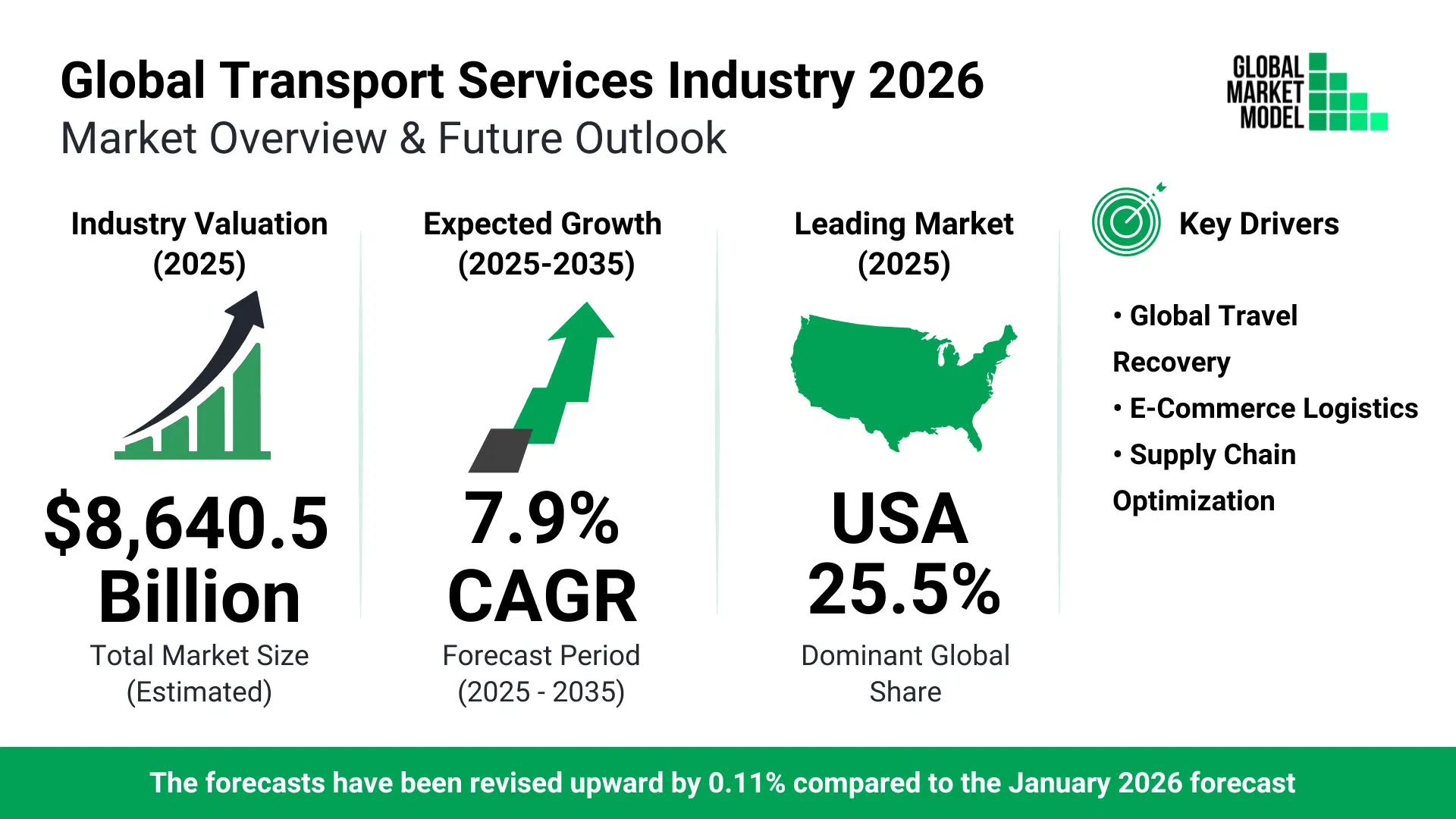
The world's most comprehensive database
- For further information and inquiries:
Global Market Model - Europe: +44 788 2955 267
- Asia: +44 788 2955 267 & +91 88972 63534
- America: +1 310 496 7795
Utilities Market Growth Driven by Renewable Energy Investment, Grid Modernization, and Electrification
Global Utilities Market Forecast Shows Steady Growth Through 2035
According to the latest Global Market Model forecast, the global utilities market was valued at $7,126.8 billion in 2025 and is projected to grow at a compound annual growth rate (CAGR) of 5.8% from 2025 to 2035. Growth is expected to be driven by rising investment in renewable power generation, increasing electricity demand from transportation, and the growing deployment of smart grids. Continued electrification of industrial processes, government support for clean energy, and modernization of aging utility infrastructure are also expected to support market expansion throughout the forecast period.
What's Driving Growth in the Global Utilities Market?
The utilities sector is undergoing significant transformation as governments and utility providers invest in cleaner, smarter, and more resilient energy systems.
Key growth drivers include:
- Increasing investment in renewable power generation
- Growing adoption of electricity in transportation
- Rising demand for smart grid technologies
- Electrification of industrial processes
- Government initiatives promoting clean energy adoption
- Modernization of aging energy infrastructure
These trends are strengthening the transition toward more efficient and sustainable utility networks while supporting long-term demand for electricity, water, and gas services.
Electric Power Generation, Transmission, and Distribution Remain the Largest Segment
The electric power generation, transmission, and distribution segment accounted for 75.3% of the global utilities market in 2025, making it the largest segment within the industry.
Overall, the utilities market represented 6.0% of global GDP in 2025.
Demand continues to be supported by:
- Government investment in utility infrastructure
- Rapid urbanization
- Growing electricity consumption
- Large investments in electricity generation capacity
- Strong demand from manufacturing industries
These factors continue to reinforce the importance of reliable utility services across residential, commercial, and industrial sectors.
China Remains the Largest Utilities Market
China accounted for 23.1% of the global utilities market in 2025, supported by large-scale investments in power generation, grid infrastructure, and industrial development.
The country's continued expansion of renewable energy capacity and electricity infrastructure reinforces its position as the world's largest utilities market.
Energy Transition and Grid Modernization Continue to Support Market Stability
The July 2026 Global Market Model forecast remains largely stable compared with the previous forecast.
Over the past six months, steady consumption of electricity, water, and natural gas across residential, commercial, and industrial users has supported market growth. Continued investment in grid modernization, renewable energy integration, and infrastructure maintenance has further strengthened the sector, supported by relatively stable regulatory frameworks in many regions.
Although fuel price volatility and geopolitical developments, including the Iran-Israel conflict, have influenced energy markets and input costs, the overall impact has remained moderate due to regulated pricing structures in many countries. Continued investment in energy transition, infrastructure resilience, and sustainability initiatives is expected to support stable near-term performance and positive long-term growth.
The Global Market Model provides comprehensive utilities market intelligence, including:
- Electricity generation
- Amount of sewage treated
- Electricity generation from oil
- Electricity generation from hydropower
- Electricity generation from coal
- Electricity generation from natural gas
- Electricity generation from nuclear sources
- Electricity generation from renewable sources
- Number of enterprises
- Number of employees
Want deeper insights into the global utilities market, country-level forecasts, and industry benchmarks?Request a Demo
The Global Market Model is the world's largest database of market forecasts. Forecasts for over 30,000 markets are updated semi-annually on the basis of economic, geo-political and sector-specific factors. The current forecast was made in July 2026, revising the previous forecasts made in January 2026.
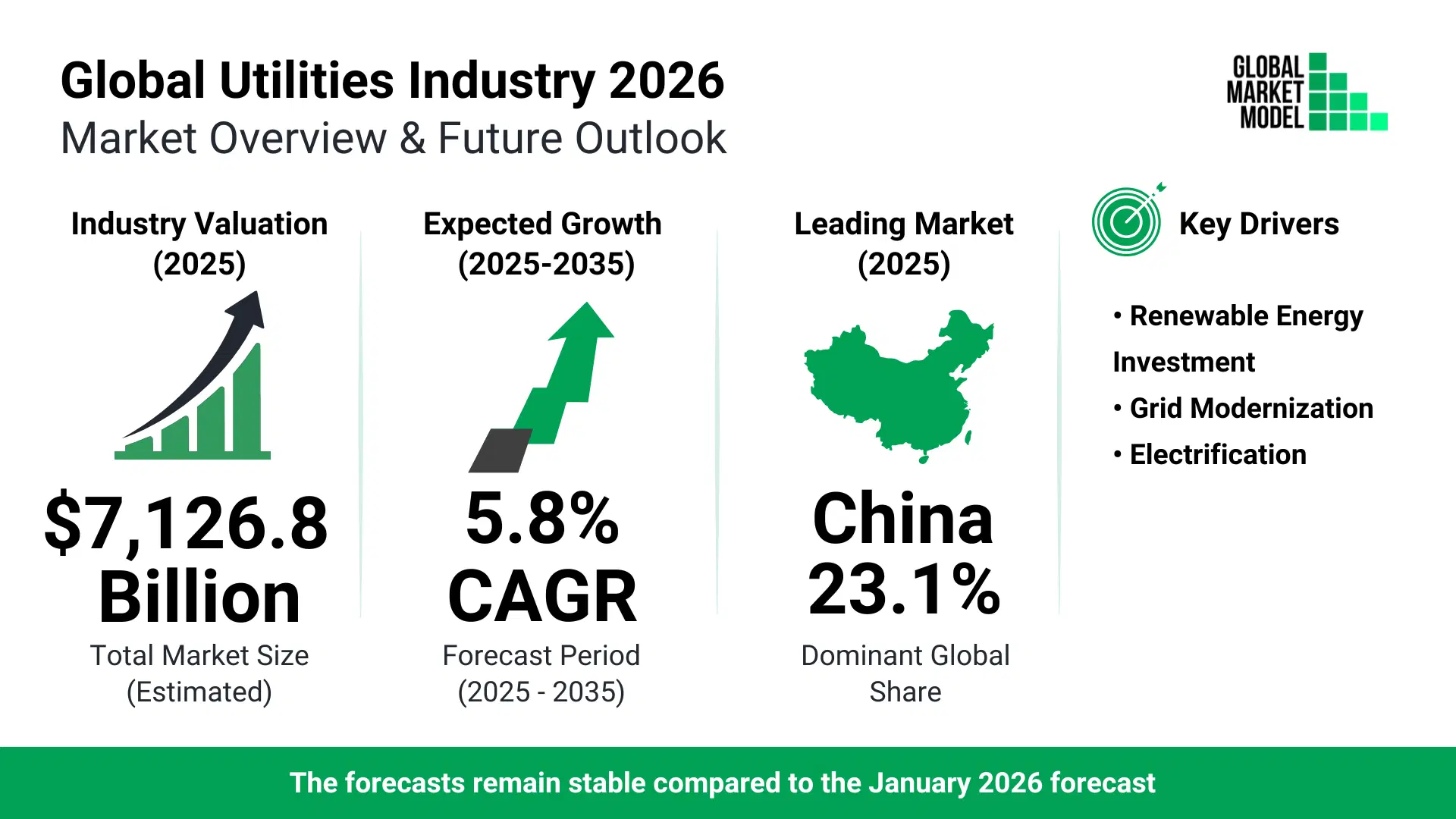
The world's most comprehensive database
- For further information and inquiries:
Global Market Model - Europe: +44 788 2955 267
- Asia: +44 788 2955 267 & +91 88972 63534
- America: +1 310 496 7795
Preventive Pet Care, Pet Insurance, and Advanced Veterinary Treatments Shape the Future of the Veterinary Healthcare Market
Global Veterinary Healthcare Market Forecast Shows Strong Growth Through 2035
According to the latest Global Market Model forecast, the global veterinary healthcare market was valued at $226.8 billion in 2025 and is projected to grow at a compound annual growth rate (CAGR) of 7.2% from 2025 to 2035. Growth is expected to be supported by increasing penetration of pet insurance, growing availability of sophisticated treatment options, and rising awareness of preventive and specialty pet healthcare. Continued focus on animal welfare, together with advances in veterinary equipment and pharmaceuticals, is also expected to support market expansion over the forecast period.
What's Driving Growth in the Global Veterinary Healthcare Market?
The veterinary healthcare sector continues to evolve as pet owners, livestock producers, and governments place greater emphasis on animal health, disease prevention, and access to advanced treatment options.
Key growth drivers include:
- Increasing penetration of pet insurance
- Growing availability of advanced veterinary treatment options
- Rising awareness of preventive and specialty pet healthcare
- Greater focus on animal welfare
- Technological advancements in veterinary equipment
- Continued innovation in veterinary pharmaceuticals
These developments are improving access to quality veterinary care while supporting greater adoption of diagnostics, vaccines, surgical procedures, and preventive healthcare services.
Veterinary Services Continue to Lead the Market
The veterinary services segment accounted for 74.4% of the global veterinary healthcare market in 2025, making it the largest segment within the industry.
Overall, the market represented 0.2% of global GDP in 2025.
Demand continues to be supported by:
- Growing pet ownership worldwide
- Rising spending on companion animal healthcare
- High prevalence of diseases among pets and livestock
- Strict animal health regulations and food safety standards
- Strong demand for effective veterinary care
These factors continue to strengthen demand for veterinary services across both companion animal and livestock healthcare.
The United States Remains the Largest Veterinary Healthcare Market
The United States accounted for 43.4% of the global veterinary healthcare market in 2025, supported by high pet ownership, significant spending on animal healthcare, advanced veterinary infrastructure, and widespread adoption of pet insurance.
Continued investment in veterinary innovation and companion animal care reinforces the country's leadership in the global veterinary healthcare market.
Preventive Care and Animal Health Investments Support a Stable Market Outlook
The July 2026 Global Market Model forecast remains largely stable compared with the previous forecast.
Over the past six months, steady spending on animal healthcare, rising pet ownership, and continued demand for livestock disease management have supported market growth. Increasing awareness of animal health, expansion of preventive care, and advancements in veterinary diagnostics, vaccines, and treatment solutions have further strengthened the sector.
Although inflationary pressures, supply chain challenges, and geopolitical developments, including the Iran-Israel conflict, have increased input costs and affected distribution in certain regions, the overall market has remained resilient. Continued emphasis on animal welfare, food safety, and technological innovation is expected to support stable near-term performance and positive long-term growth.
The Global Market Model provides comprehensive veterinary healthcare market intelligence, including:
- Number of dentists
- Number of hospitals
- Number of MRI units
- Number of nurses
- Number of pharmacies
- Number of pharmacists
- Number of physicians
- Number of surgical procedures
- Parkinson prevalence rate
- Peptic ulcer prevalence rate
- Private healthcare expenditure
- Public healthcare expenditure
- Rheumatoid arthritis prevalence rate
- Thalassemia prevalence rate
- Tuberculosis prevalence rate
Want deeper insights into the global veterinary healthcare market, country-level forecasts, and industry benchmarks?Request a Demo
The Global Market Model is the world's largest database of market forecasts. Forecasts for over 30,000 markets are updated semi-annually on the basis of economic, geo-political and sector-specific factors. The current forecast was made in July 2026, revising the previous forecasts made in January 2026.
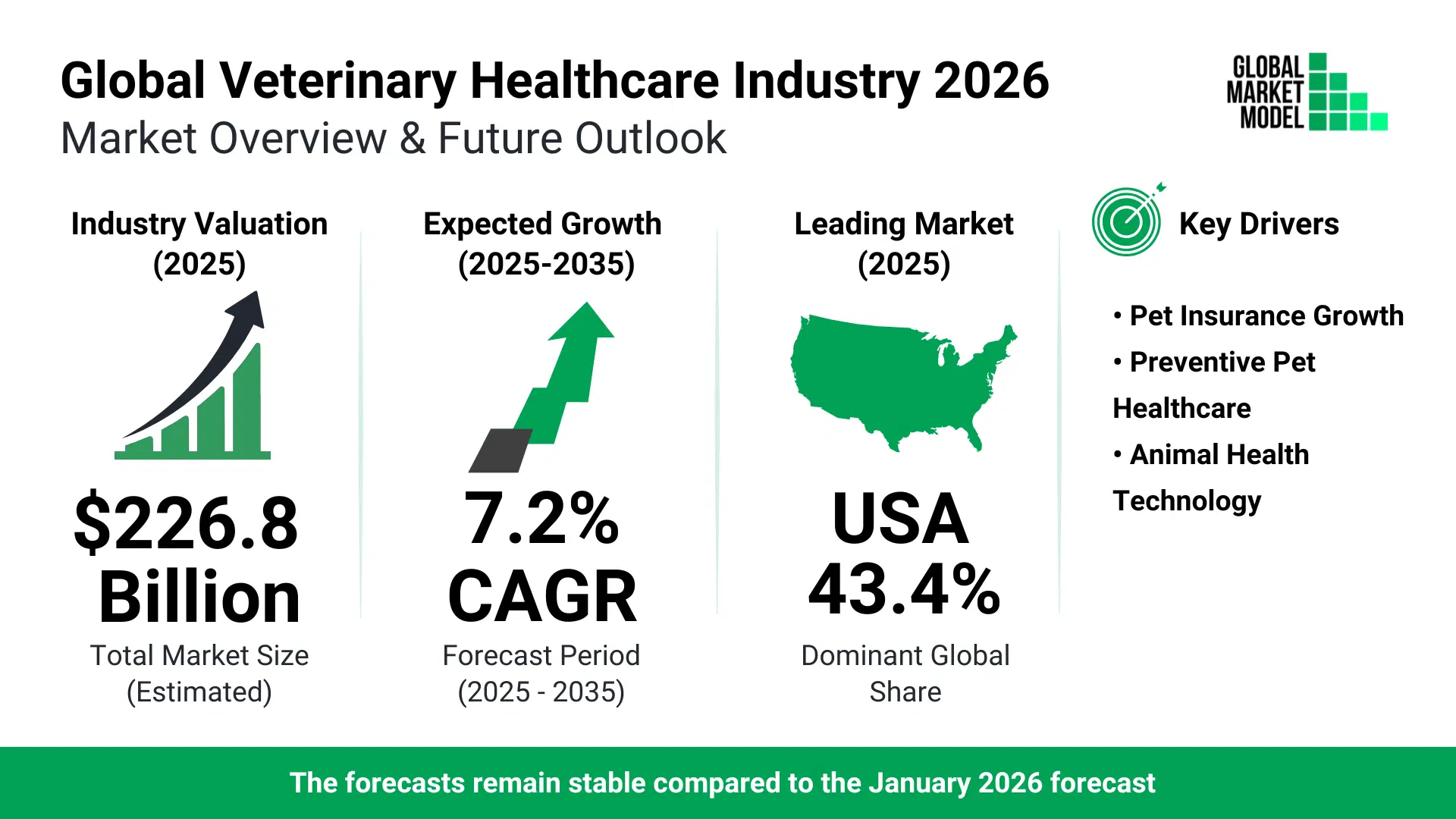
The world's most comprehensive database
- For further information and inquiries:
Global Market Model - Europe: +44 788 2955 267
- Asia: +44 788 2955 267 & +91 88972 63534
- America: +1 310 496 7795